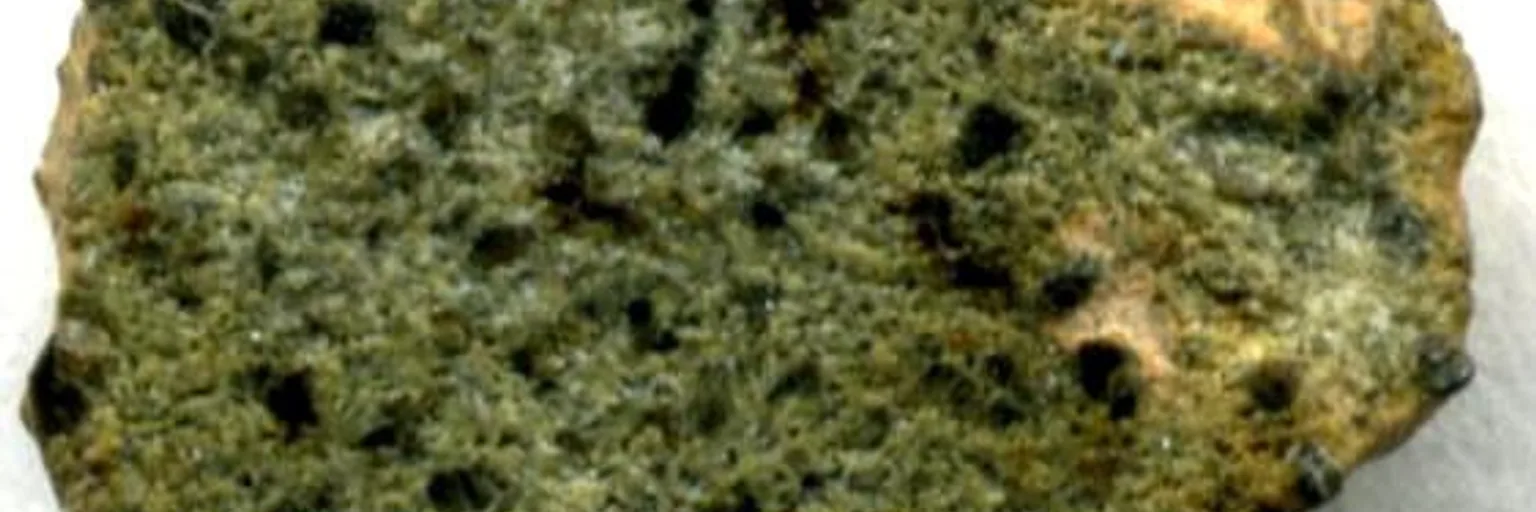
Mars isn't "alive": a whiff of gas should steer missions, not hopes
Hydrogen chloride over Alba Mons suggests Mars still has a working interior. That is a reason to rethink where we look for life, not to announce it.
Photo: NASA, ESA, STScI / Wikimedia Commons (CC BY 4.0)
How did a planet that spent decades being filed under "dead" become "alive" overnight? Headlines this week have gone from "Mars isn't dead" to "proof of life" in a few hours. The science behind them is more interesting than that, and considerably more modest.
Here is what was actually reported. A study in Science Advances, co-led by Alexander Trokhimovskiy and Daniel Mège, used the ExoMars Trace Gas Orbiter to detect hydrogen chloride in the low atmosphere above surface fissures near Alba Mons, as RNZ reports. The gas spikes every year on the volcano's northern flank in early summer. The authors suspect the fissures may be blocked by ice at other times of the year and that thawing as temperatures rise lets trapped volcanic gas escape. Mège says the most likely origin is "volcanic seepage."
"Still active" is a hypothesis with a good argument, not a verdict
Notice the verbs. The gas "can be consistent with" magmatic degassing; the planet's interior "may" retain enough heat. That is careful language, and it should be. The detection is a trace gas seen from orbit, and the volcanic origin is an inference about where it comes from. In our view it is a strong inference, partly because the signal follows a seasonal pattern tied to a specific place. But as far as the reported findings go, nobody has seen lava, and nothing is described as having erupted.
It's also worth keeping the baseline in view. Mège himself notes that evidence of volcanism from a few million years ago had been reported, but none of current magmatic activity. So this is a step from "recent" to "possibly ongoing." That is a real step. It is not a revolution, and we'd wait for independent confirmation before treating Alba Mons as a settled active volcano.
Geologically warm is not the same as biologically promising
Here is where the coverage goes off the rails. Some outlets jump from degassing magma to "proof of life" (the Daily Star's headline literally says so). The reported research supports nothing of the kind. What the researchers say is narrower: rising magma could heat underground water, creating hydrothermal environments that may support microbial life, which Trokhimovskiy calls among the most promising targets in the search for life on Mars.
"Promising targets" is the key phrase, and the operative word is targets. A heat source is one ingredient. Water, chemistry and stability over long periods are others, and we haven't seen anything showing they come together at Alba Mons. Hydrogen chloride is also corrosive and pungent, which is a fun fact and a reminder that volcanic chemistry is not automatically friendly chemistry. Life on Earth is thought to have first emerged in hydrothermal systems, but that makes them a good place to look, not a place where we should expect to find anything.
We'd go further: conflating "geologically active" with "habitable" actively damages the case. If the public learns that Mars is "alive" and then a future mission finds nothing, the disappointment lands on the science rather than on the headline writers.
What this should change: the map, not the mood
The practical value is that this gives mission planners something rare, a location with a measurable signal and a reason to care. Atmospheric trace gases, as Trokhimovskiy puts it, can reveal geological activity that is otherwise hard to observe directly. We think that makes orbiters like TGO a prospecting tool for the subsurface, and it should nudge the target list toward warm, fissured terrain.
There's also a broader point. Confirmed volcanically active bodies are, as RNZ puts it, an elite club: Earth, Venus and Jupiter's moon Io. Adding Mars, even provisionally, makes the planet a more dynamic place than the dusty relic of our textbooks. That is worth being excited about on its own terms, without borrowing the excitement of aliens.
Our verdict: celebrate the detection, and wait for corroboration before rewriting the textbook. Treat Alba Mons as a high-value place to point instruments, and treat every "Mars is alive" headline as a sign that the story has been oversold. A planet with a warm interior is a better scientific target. It is not yet a better bet for biology.
No topics yet: start the first one.
More stories
Swift's fall shows satellite rescue can't be improvised
A telescope that outlived its two-year mission more than tenfold fell after its rescuer failed. Servicing has to be designed in before a satellite is dying.
Webb's dust factories are a clue, not proof: the early universe is being read by proxy
Webb caught metal-poor stars making dust in a nearby dwarf galaxy. That's a real step for cosmic chemistry, but it stands in for the early universe rather than showing it.
The orbital nuke warning is really about our satellite dependence
The Pentagon's report on a Russian nuclear satellite matters less as a treaty scandal than as a stress test of how much of daily life hangs on fragile orbital hardware.

Thirteen possible homes for one Mars rock is a feature, not a flaw
A 4.1-billion-year-old meteorite with 13 candidate source sites shows how little a rock's age tells us without its geological setting, and why Mars sample return still matters.