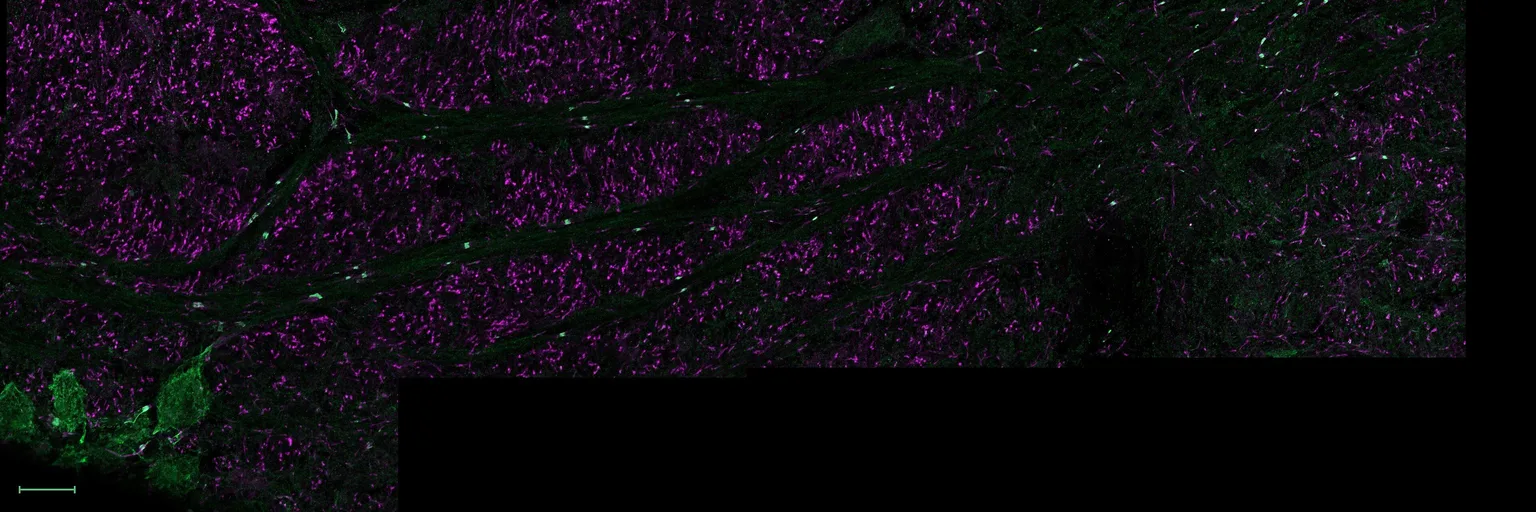
Childhood cancer maps have blind spots, and that's progress
Aggressive cells hiding in pediatric tumors labeled lower-risk show how incomplete our cancer maps are. It's a real research step, but not yet a change in treatment.
AI-generated image
What good is a risk map if the most dangerous territory isn't on it? That is the uncomfortable question behind a new study on childhood cancer, and the answer is more interesting than the headlines suggest.
A team at the Wellcome Sanger Institute, working with researchers from the University of Cambridge, University College London and Great Ormond Street Hospital, has found populations of aggressive cells in some pediatric tumors that were not expected to harbor them. As ScienceDaily summarizes, the findings were published in Cancer Research and look at why some "lower-risk" childhood cancers turn deadly. According to Tom's Hardware Italia, the work covers 16 children and points to aggressive cells in certain rhabdomyosarcomas that lack the genetic marker normally used to flag high risk.
The label said "lower risk." The tumor disagreed
Here is the idea worth holding onto. Clinicians sort tumors into risk categories because treatment has to be calibrated: too little and the child relapses, too much and the child pays for it for decades. That sorting depends on markers, and a marker is only as good as the biology it captures. If a tumor can be dangerous without carrying the marker, the category was never a guarantee. It was a useful approximation.
That is what we find most revealing here. We read the study not as proof that the old classification is wrong, but as a sign that, in some cases, it is incomplete. A tumor can look reassuring on the standard checklist while some of its cells behave very differently. According to the summary on The Solver, this could explain why some rhabdomyosarcoma cases become unexpectedly lethal. In our view, "unexpectedly" is the key word. Medicine hates surprises, and each one points to a place where our map doesn't match the terrain.
Sixteen children is a signal, not a verdict
Now the brake. Some headlines on this story suggest it changes how patients are treated. The coverage we reviewed doesn't support that. What it supports is a more modest and more honest claim: a small study, in a limited number of patients, identified aggressive cells that might allow more precise diagnosis. The sources speak in the conditional: the finding could help doctors identify dangerous tumors earlier and develop personalized treatments. That is a hypothesis about the future, not a clinical protocol.
The distance between those two things is large. A finding like this has to be reproduced in larger groups, and someone has to show that identifying these cells actually predicts outcomes better than what is already used. Then someone has to show that acting on that information improves survival without adding needless harm. None of that has been shown in what we've seen, and we won't pretend otherwise. A cell type seen in 16 children tells us where to look. It doesn't tell us what to do once we've looked.
There is also a point about expectations. Childhood cancers are comparatively rare, so samples tend to be small. That probably makes studies like this one more valuable as clues, and makes it more tempting to oversell them.
What deserves applause, and what deserves patience
Applause, first. Finding aggressive cells where nobody expected them is exactly how a field improves. It is the kind of result that tends to justify looking more closely at tumors we thought we understood, and it is especially welcome in children, where the cost of misjudging risk falls on very young patients.
Patience, second. If you are a parent, or simply someone following the news, the sensible reading is this: nothing changes in the clinic tomorrow, and nobody should interpret a "lower-risk" diagnosis today as less serious because of a study that hasn't yet been turned into a test. Treatment decisions belong with the oncology team and the validated criteria they use.
Our verdict: this is a good map correction, not a new route. The real test will come when someone checks, in larger cohorts and with proper follow-up, whether these hidden cells can be spotted early and whether spotting them leads to better care. Until then, treat it as what it is, a reminder that in cancer, "we've mapped it" almost always means "we've mapped what we knew how to see."
No topics yet: start the first one.
More stories
Biology studied cells in snapshots; live 3D film shows what we missed
Filming the inside of a living cell in 3D turns biology from a photo album into cinema, as long as we can prove the camera doesn't change the plot.
Vitamin A and vision: a mechanism update, not a prescription
A Johns Hopkins study on how sharp vision is built before birth reminds us how much we still don't know about the eye, and why it shouldn't be sold as a pill.
Quantum sensors could replace animal tests for drug safety, if they prove themselves
NASA and the NIH want quantum sensors to read organ-on-a-chip models without animals. It's a smart bet, but only if the readings are checked against real physiology.
Revived mouse brain tissue is real progress, but not a mind
German researchers kept mouse brain tissue functional after vitrification. That is a genuine preservation advance, and cryonics hype should not borrow its credibility.