Cosmic Collisions: How Black Holes Redraw Galactic Maps
Recent discoveries of unusual galaxies, shaped by ancient collisions, reveal supermassive black holes are not just passive inhabitants but active forces dictating galactic evolution.
AI-generated image
What if the galaxies we see, seemingly stable and timeless, are actually cosmic battlefields, their structures permanent records of violent pasts? Recent breakthroughs in observational astronomy suggest precisely that, revealing unusual galaxies whose current forms are direct consequences of ancient, dramatic collisions. These discoveries are not merely adding new celestial objects to our catalogs; they are fundamentally reshaping our understanding of how supermassive black holes actively orchestrate the evolution of stellar systems.
Our view of galactic dynamics has been profoundly enhanced by the James Webb Space Telescope (JWST) and the Hubble Space Telescope. For instance, Hubble's recent observations of NGC 4698, a spiral galaxy some 55 million light-years away in the Virgo Cluster, reveal an astonishing peculiarity: its central bulge of older, cooler stars rotates perpendicularly to the rest of the disk. This sideways spin, along with a short tail of hydrogen, strongly suggests a minor merger event in its past, where incoming gas settled into a tilted central disk. Meanwhile, the JWST has turned its gaze on Centaurus A, a relatively nearby and highly active galaxy just 11 million light-years from Earth. Images released on July 6, 2026, highlight its distorted dust lanes and cosmic filaments, clear evidence of a massive collision that occurred approximately two billion years ago, a cosmic event whose impact continues to shape the galaxy's structure and ongoing star formation.
The Scars of Cosmic Violence Define Galactic Identity
The most compelling takeaway from these observations is how galactic mergers leave indelible marks on their structure and evolution. In NGC 4698, the sideways-spinning core, with its supermassive black hole drawing in gas, suggests that captured material from a minor merger settled into a tilted central disk, altering its dynamics. Similarly, Centaurus A's distorted dust lanes, captured by Webb, are tangible evidence of a colossal collision two billion years ago, with the galaxy's central supermassive black hole actively shaping its environment by releasing vast amounts of energy as it feeds. This highlights not just the scars of violence, but the ongoing influence of these cosmic titans.
Beyond the Core: Supermassive Black Holes as Architects of New Realities
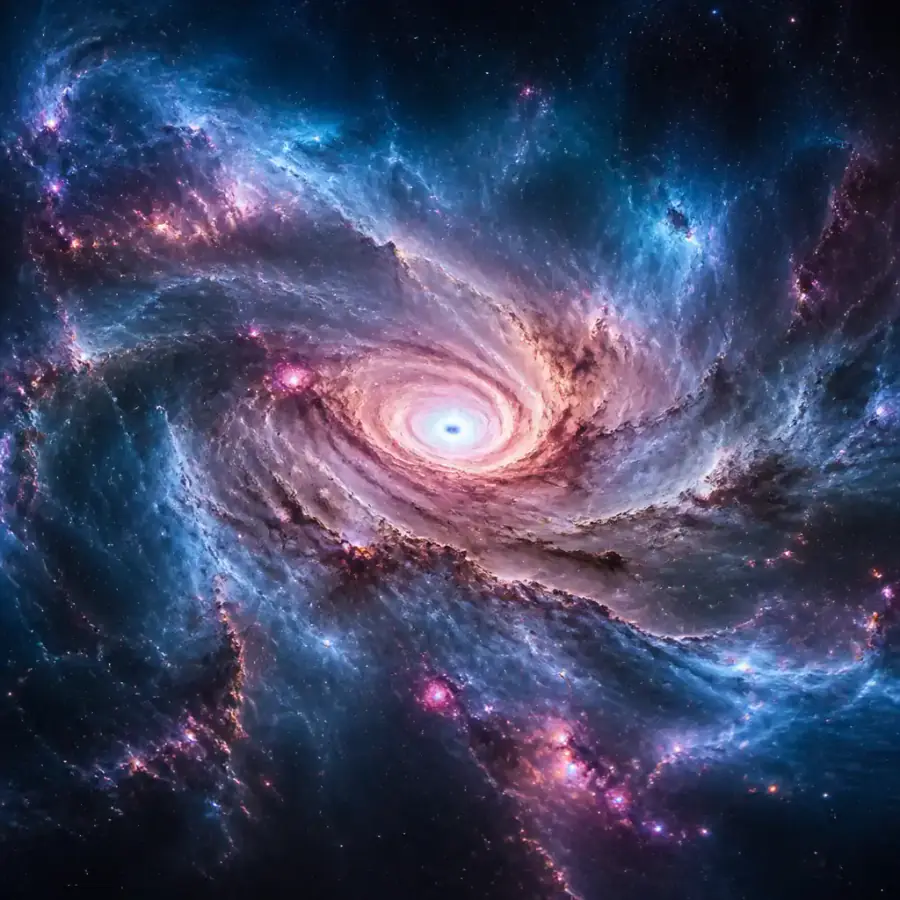
These discoveries push us to rethink the role of supermassive black holes. They are not merely gravitational anchors at galactic centers; they are dynamic participants in cosmic evolution, capable of being created or relocated through violent events. The James Webb Space Telescope recently identified a truly unique system, dubbed "Galaxy ∞", whose distinctive morphology resembles the infinity symbol. This system, located approximately 4.5 billion years after the Big Bang, presents compelling evidence for supermassive black holes forming through a process known as "direct collapse," a theoretical mechanism previously unobserved directly.
What makes "Galaxy ∞" revolutionary is the location of its supermassive black hole: it resides between two colliding galactic nuclei, not within either. This unprecedented positioning, observed with multi-wavelength data including X-rays from the Chandra observatory and radio observations from the Very Large Array, suggests the black hole formed precisely where two dense gas clouds collided during the galactic merger. This direct observation challenges previous theoretical models by providing empirical evidence that these cosmic leviathans can emerge directly from the gravitational collapse of turbulent gas during galactic collisions.
Such findings illuminate the profound impact of galactic collisions, not only in reshaping stellar populations and gas distributions but also in the very creation and migration of supermassive black holes. Simulations further indicate that wandering supermassive black holes can exist far from galactic centers, particularly after mergers, carrying historical traces of their original galaxies. This means that the galactic maps we are constantly redrawing are not static diagrams, but dynamic blueprints shaped by cataclysmic encounters and the powerful, active roles of their supermassive black hole residents.
No topics yet: start the first one.
More stories
Beyond the Splashdown: Crew-12's Lasting Blueprint for Space Endurance
The successful 237-day mission of NASA's Crew-12 underscores that true space exploration is less about the spectacle and more about the quiet, sustained dedication to scientific advancement in orbit.
Molecular Fingerprints: Gold Nanogap Sensor Redefines Search for Alien Life
A groundbreaking electrical nanogap sensor, developed by Osaka University, promises to revolutionize astrobiology by accurately distinguishing the chiral forms of amino acids, offering a robust method to detect life's unique molecular signature.

Space's 'Rocket Revolution' Demands a Sustainability Reckoning
The surge in commercial spaceflight, celebrated during World Space Week, highlights an urgent need for global cooperation on orbital debris and long-term sustainability.
Neutrino Astronomy's Nobel: A New Universe Unveiled in Antarctic Ice
Francis Halzen's pioneering vision for the IceCube Neutrino Observatory has transformed our cosmic perception, opening an entirely new window into the universe's most violent and enigmatic phenomena.