Neutrino Astronomy's Nobel: A New Universe Unveiled in Antarctic Ice
Francis Halzen's pioneering vision for the IceCube Neutrino Observatory has transformed our cosmic perception, opening an entirely new window into the universe's most violent and enigmatic phenomena.
AI-generated image
What if the universe has been speaking to us in a language we could barely decipher, its most violent and energetic events leaving only faint, ghost-like traces? This is precisely the challenge, and the triumph, recognized by the Royal Swedish Academy of Sciences in awarding the 2026 Nobel Prize in Physics to Francis Halzen. His groundbreaking work on the IceCube Neutrino Observatory isn't merely a discovery about elusive subatomic particles; it represents the birth of an entirely new way to perceive the cosmos, promising to unlock phenomena previously hidden from our view.
Halzen, a professor at the University of Wisconsin–Madison, was honored “for decisive contributions to the IceCube Neutrino Observatory and the discovery of high-energy neutrinos of astrophysical origin,” as announced by NobelPrize.org on October 6, 2026. His vision transformed a radical idea – using a cubic kilometer of Antarctic ice as a giant detector – into a reality that now allows us to observe the most extreme and distant corners of the universe through a unique lens: neutrinos.
Solving the Universe's Most Elusive Puzzle
Neutrinos are often dubbed “ghost particles” for good reason. These elementary particles are electrically neutral, have almost no mass, and rarely interact with other matter. Trillions of them zip through our bodies every second without us ever noticing, as Smithsonian Magazine highlights. While low-energy neutrinos are produced by common astrophysical phenomena like the sun's nuclear fusion, high-energy neutrinos are distinct. They originate from the universe's most violent processes, such as exploding stars or supermassive black holes gorging themselves.
Unlike charged cosmic rays, which are deflected by magnetic fields and arrive from random directions, neutrinos travel in straight lines and maintain their initial direction and energy. This makes them invaluable messengers, carrying pristine information directly from their extreme origins. The challenge, however, has always been their elusive nature. Early attempts to detect them using large bodies of water, such as off the coast of Hawaii, faced technical difficulties, including noise from light-emitting marine organisms, leading to project abandonment, as American Physical Society reports.
Halzen's stroke of genius, first presented in 1988, was recognizing that the deep, dark, and clear glacial ice at the South Pole offered a superior medium for detection. This environment is free from interference, geologically stable, and has very low levels of radioactive substances. The principle is elegant: when a high-energy neutrino rarely collides with an atomic nucleus within the ice, it produces a faint flash of blue light, known as Cherenkov radiation. Sensors embedded in the ice can then detect this light, allowing researchers to track the neutrino's arrival direction and energy, pointing back to its cosmic source.
IceCube: A Kilometer-Scale Eye on the Universe
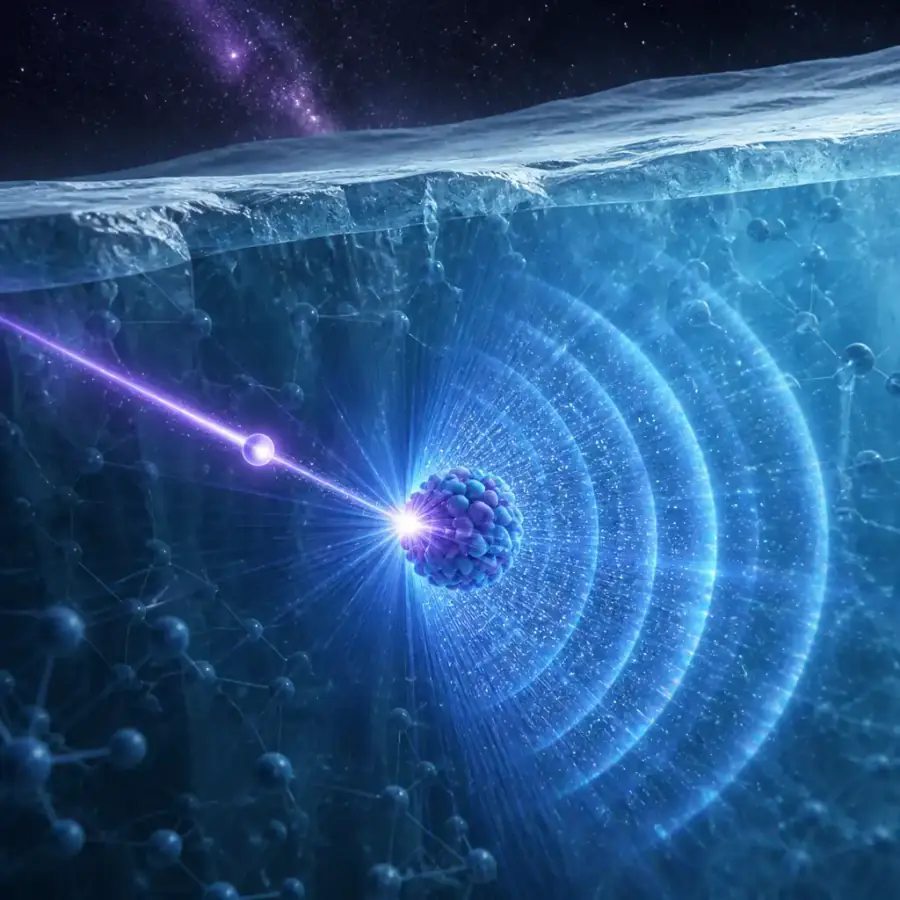
Halzen's initial vision matured through precursor experiments like AMANDA, which helped prove the concept and provided crucial technical insights, such as the need for sensors to be deeply embedded to avoid light-scattering bubbles. With funding from the U.S. National Science Foundation in 2002, the construction of IceCube began in 2004 and was completed in 2011. The observatory is a marvel of engineering, comprising 5,160 optical sensors strung along 86 vertical lines, dangling into the ice at depths between 1.4 and 2.4 kilometers. This arrangement effectively transforms a cubic kilometer of Antarctic ice into the world's largest neutrino telescope.
Soon after its completion, IceCube began to yield groundbreaking results. In 2013, researchers reported the first compelling evidence of high-energy neutrinos originating from beyond our solar system. This was followed by a more definitive report in 2014, detailing 37 high-energy neutrino events, firmly establishing their extra-galactic origin. As Mark Pearce, Chair of the Nobel Committee for Physics, stated, Halzen’s tenacity and scientific vision “has paved the way for a new kind of astronomy.”
The Dawn of Multi-Messenger Astronomy
Neutrino astronomy doesn't operate in isolation. It is a crucial pillar of multi-messenger astronomy, alongside cosmic rays, gravitational waves, and electromagnetic radiation (light). By combining these independent signals, researchers can study distant cosmic events with unprecedented detail. For instance, IceCube has traced high-energy neutrinos back to supermassive black holes and even created the first image of our own Milky Way Galaxy using neutrinos, as Astronomy.com highlights.
The ongoing operation of IceCube, coupled with complementary projects like Baikal-GVD in Siberia and KM3NeT in the Mediterranean Sea, signifies a global effort to create a network of neutrino telescopes. This collaborative endeavor promises to continuously monitor the entire sky, offering novel knowledge about the violent settings where high-energy neutrinos are created and potentially revealing previously unknown cosmic phenomena. Francis Halzen's Nobel Prize is not just a recognition of past achievements; it is a validation of a powerful new way to explore the universe, one that has only just begun to show its true potential.
No topics yet: start the first one.
More stories
Beyond the Splashdown: Crew-12's Lasting Blueprint for Space Endurance
The successful 237-day mission of NASA's Crew-12 underscores that true space exploration is less about the spectacle and more about the quiet, sustained dedication to scientific advancement in orbit.

Cosmic Collisions: How Black Holes Redraw Galactic Maps
Recent discoveries of unusual galaxies, shaped by ancient collisions, reveal supermassive black holes are not just passive inhabitants but active forces dictating galactic evolution.
Molecular Fingerprints: Gold Nanogap Sensor Redefines Search for Alien Life
A groundbreaking electrical nanogap sensor, developed by Osaka University, promises to revolutionize astrobiology by accurately distinguishing the chiral forms of amino acids, offering a robust method to detect life's unique molecular signature.
Space's 'Rocket Revolution' Demands a Sustainability Reckoning
The surge in commercial spaceflight, celebrated during World Space Week, highlights an urgent need for global cooperation on orbital debris and long-term sustainability.