Beyond the Splashdown: Crew-12's Lasting Blueprint for Space Endurance
The successful 237-day mission of NASA's Crew-12 underscores that true space exploration is less about the spectacle and more about the quiet, sustained dedication to scientific advancement in orbit.
AI-generated image
The triumphant splashdown of NASA's SpaceX Crew-12 mission on October 8, 2026, was undoubtedly a moment of exhilaration, marking the safe return of four astronauts after 237 days in orbit. Yet, as the headlines celebrate the successful conclusion, we must ask: are we focusing enough on the endurance of these missions, rather than just the spectacle of their beginnings and ends? While launches and returns offer thrilling visuals, the real story of human spaceflight lies in the sustained presence and meticulous work performed far above our heads.
The international crew — NASA astronauts Jessica Meir and Jack Hathaway, ESA astronaut Sophie Adenot, and Roscosmos cosmonaut Andrey Fedyaev — returned to Earth in a SpaceX Crew Dragon capsule, touching down in the Pacific Ocean off the coast of Los Angeles. Their journey spanned more than 100 million miles and over 3,792 orbits around Earth, a testament to the remarkable capabilities of modern space technology and, crucially, the human spirit. This mission, the 12th operational flight under NASA’s Commercial Crew Program, was a long-duration science expedition, designed to push the boundaries of our understanding in microgravity.
The Quiet Endurance of Orbit
For 237 days, these four individuals lived and worked in an environment fundamentally alien to human existence. This isn't merely a trip; it's an extended residency in an orbital laboratory, demanding constant adaptation to weightlessness, confinement, and separation from Earth. As NASA Administrator Jared Isaacman noted, this repeated capability to live and work in orbit is precisely what will allow humanity to “go farther”. We tend to fixate on the dramatic moments – the fiery ascent, the precision docking, the parachute-aided descent – but the real grit of space exploration is found in the hundreds of quiet, continuous days between.
Indeed, astronaut Jessica Meir, on her second spaceflight, reflected on what she'd miss about space: the weightlessness and the extraordinary views of Earth. Yet, her anticipation of feeling “the wind rustling through the leaves” highlights the profound human connection to our home planet that is only truly understood through its absence. This blend of longing for Earth and dedication to the extraterrestrial mission defines the astronauts' enduring experience.
Science Beyond the Spectacle
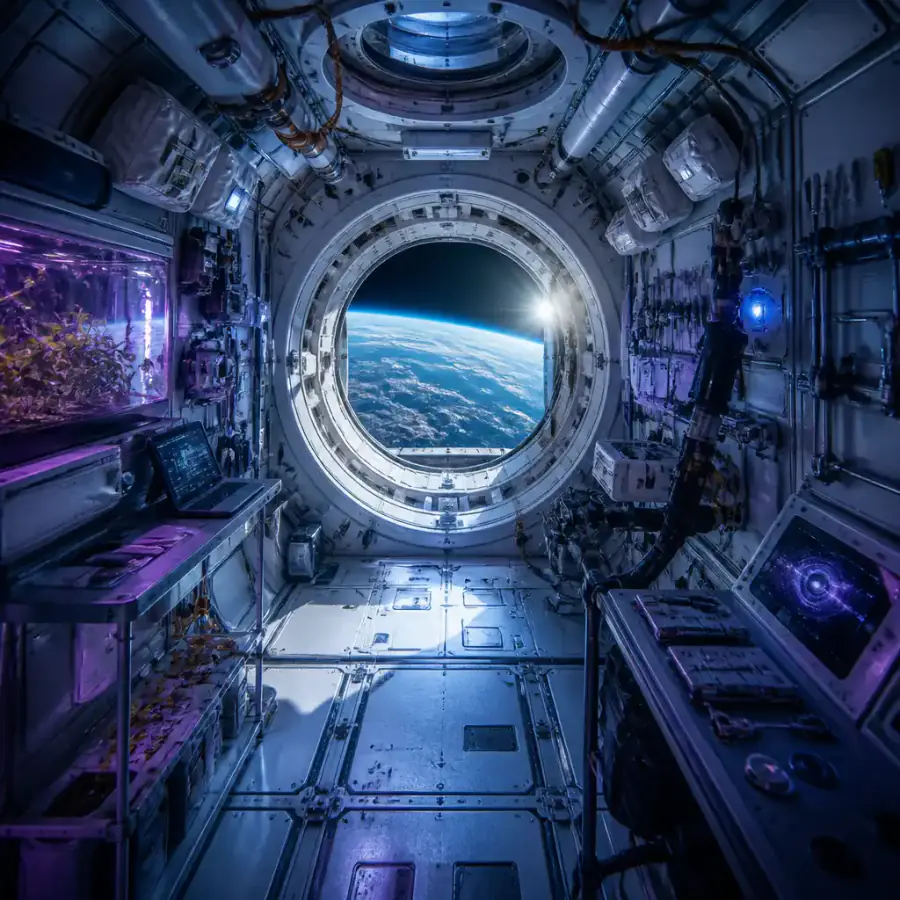
The true value of such long-duration missions lies not just in the journey, but in the scientific harvest. Crew-12 dedicated hundreds of hours to research designed to prepare us for future expeditions to the Moon and Mars, while also delivering tangible benefits back on Earth. Their work included testing stem cell production for cell-based therapies, an innovation that could revolutionize medicine, whether in orbit or on the ground. They also demonstrated on-demand IV fluid generation, a critical capability for distant, long-duration missions where resupply is infrequent or impossible.
Beyond these, the crew delved into the complex interplay between spaceflight and human health, studying how pneumonia-causing bacteria might lead to long-term heart damage and examining how physical characteristics influence blood flow in microgravity. These are not abstract experiments; they are direct efforts to mitigate the risks of human expansion into the cosmos. Furthermore, the mission saw significant achievements outside the habitat, with Jessica Meir completing four spacewalks, bringing her career total to seven and placing her third among NASA women in this regard. Sophie Adenot also made history, becoming the first French woman to perform a spacewalk.
The Unseen Backbone of Spaceflight
It is imperative to recognize that this continuous human presence on the International Space Station, now over 25 years strong, is sustained by an “extraordinary expertise and competence of thousands across NASA, SpaceX, and our international partners”. The ISS remains a critical testbed for understanding and overcoming the challenges of long-duration spaceflight, fostering unparalleled international cooperation, as exemplified by the Crew-12's diverse team and the smooth handover to Crew-13, who arrived last week.
While we celebrate the groundbreaking achievements and the safe return of Crew-12, let us not forget the profound dedication required for the intervening 237 days of work. These missions are not just about reaching space; they are about living and advancing in space, steadily building the knowledge and experience that will one day take us to the Moon and Mars. The true spectacle is the sustained human endeavor, the quiet, persistent effort that makes grand exploration possible. As Crew-12 returns, they bring with them not just scientific samples, but a renewed testament to humanity's capacity for enduring exploration.
No topics yet: start the first one.
More stories
Cosmic Collisions: How Black Holes Redraw Galactic Maps
Recent discoveries of unusual galaxies, shaped by ancient collisions, reveal supermassive black holes are not just passive inhabitants but active forces dictating galactic evolution.
Molecular Fingerprints: Gold Nanogap Sensor Redefines Search for Alien Life
A groundbreaking electrical nanogap sensor, developed by Osaka University, promises to revolutionize astrobiology by accurately distinguishing the chiral forms of amino acids, offering a robust method to detect life's unique molecular signature.

Space's 'Rocket Revolution' Demands a Sustainability Reckoning
The surge in commercial spaceflight, celebrated during World Space Week, highlights an urgent need for global cooperation on orbital debris and long-term sustainability.
Neutrino Astronomy's Nobel: A New Universe Unveiled in Antarctic Ice
Francis Halzen's pioneering vision for the IceCube Neutrino Observatory has transformed our cosmic perception, opening an entirely new window into the universe's most violent and enigmatic phenomena.