Space's 'Rocket Revolution' Demands a Sustainability Reckoning
The surge in commercial spaceflight, celebrated during World Space Week, highlights an urgent need for global cooperation on orbital debris and long-term sustainability.
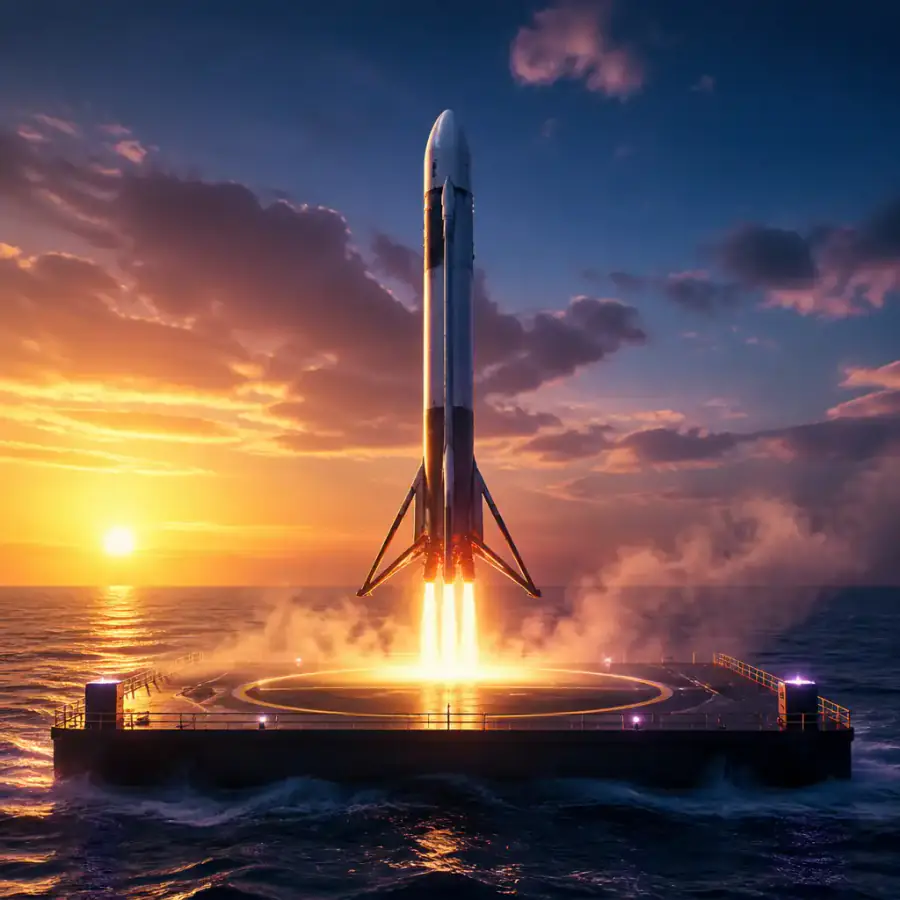
AI-generated image
Is space becoming too accessible for its own good? As World Space Week 2026 draws to a close this Saturday, October 10, the resounding theme of “Rocket Revolution” celebrates a future where orbital access is no longer the exclusive domain of a few national agencies. Yet, this very revolution, marked by reusable rockets and burgeoning commercial endeavors, compels us to consider the crucial question of how humanity will manage this increasingly crowded frontier responsibly.
This year’s World Space Week, a United Nations-declared annual event running from October 4 to 10, serves as a timely reminder of the incredible advancements in space science and technology. We saw the return of four astronauts from the International Space Station, including ESA astronaut Sophie Adenot, who departed the ISS with the Crew-12 mission on October 7. This year also brought the ambitious first orbital flight of SpaceX’s Starship — the world’s largest rocket at over 400 feet tall — at the end of September. The weeklong celebration includes hundreds of events in over 100 nations, emphasizing STEM education and industry growth, even featuring a partnership between the European Space Agency and Pokémon, which saw an ESA astronaut take a Pikachu plush to the ISS for 67 days. But beyond the public engagement and the sheer spectacle, a fundamental shift is underway in how we reach and use space, driven largely by reusable rocket technology.
The Democratization of Orbit
The “Rocket Revolution” is not just a catchy theme; it reflects a profound transformation in space access. Once, reaching orbit was an expensive, one-shot endeavor dominated by national governments. Today, commercial providers like SpaceX and Blue Origin are not only increasing their operations but also pioneering reusable rocket boosters. This method has made manufacturing spacecraft cheaper and led to faster turnaround times between missions, fundamentally altering the economics of spaceflight. SpaceX’s Starship, for instance, is being developed as the first fully reusable launch vehicle, capable of multiple flights for both its booster and upper-stage.
This shift is dramatically expanding who can reach space. Where orbit was once the realm of major space agencies, even smaller spaceflight startups can now send spacecraft to Earth orbit and beyond. According to Dennis Stone, president of the World Space Week Association, this increased access and falling launch prices have stimulated the entire space ecosystem, encouraging exciting new applications. The sheer volume of launches is staggering: currently, about 200 orbital rockets get off the ground per year in the U.S. alone, primarily from Florida, Texas, and California. President Donald Trump has called for developing more launch sites and upgrading existing spaceports to support 1,000 launches per year — a more than fourfold increase. This growth is indeed a revolution, but every revolution has consequences.
The Shadow of Increased Access: Orbital Debris
While the “Rocket Revolution” promises unprecedented opportunities, it also casts a long shadow: the accelerating problem of orbital debris. The very success of reusable rockets and commercial enterprises, leading to more frequent launches and a proliferation of satellites, is transforming Earth's orbit into an increasingly cluttered environment. Millions of fragments and pieces of debris now surround our planet, ranging from defunct satellites and spent rocket stages to tiny paint flakes, all hurtling at orbital velocities. The UN Environment Programme has already addressed the long-term environmental effects of this activity.
Each new launch, each satellite deployment, contributes to this growing problem. The Starlink constellation, for example, represents thousands of satellites in low Earth orbit, significantly increasing the traffic. A single collision can create thousands more pieces of debris, triggering a cascade effect known as the Kessler Syndrome, which could render entire orbital regimes unusable for future missions. This isn't just a hypothetical concern; it's a tangible threat to essential services like communication, navigation, weather forecasting, and Earth observation that rely on a functional, uncompromised orbit.
A Call for Global Stewardship
The United Nations, which established World Space Week in 1999 to recognize advancements in space science and technology, has been involved in international space affairs since the early years of the space age. The Outer Space Treaty, signed on October 10, 1967 — marking the end date of World Space Week — provides the basic framework for international space law, governing how countries conduct activities in outer space. However, the commercial
No topics yet: start the first one.
More stories
Beyond the Splashdown: Crew-12's Lasting Blueprint for Space Endurance
The successful 237-day mission of NASA's Crew-12 underscores that true space exploration is less about the spectacle and more about the quiet, sustained dedication to scientific advancement in orbit.

Cosmic Collisions: How Black Holes Redraw Galactic Maps
Recent discoveries of unusual galaxies, shaped by ancient collisions, reveal supermassive black holes are not just passive inhabitants but active forces dictating galactic evolution.

Molecular Fingerprints: Gold Nanogap Sensor Redefines Search for Alien Life
A groundbreaking electrical nanogap sensor, developed by Osaka University, promises to revolutionize astrobiology by accurately distinguishing the chiral forms of amino acids, offering a robust method to detect life's unique molecular signature.

Neutrino Astronomy's Nobel: A New Universe Unveiled in Antarctic Ice
Francis Halzen's pioneering vision for the IceCube Neutrino Observatory has transformed our cosmic perception, opening an entirely new window into the universe's most violent and enigmatic phenomena.