A Name That Echoes: New Amphibian Honors Brazil's Forgotten Conservationists
The scientific recognition of Siphonops maria not only celebrates a hidden amphibian but also shines a crucial light on the enslaved individuals who pioneered one of the world's greatest rewilding efforts.
AI-generated image
What does a subterranean, worm-like amphibian have in common with a woman enslaved more than 150 years ago? More than one might imagine, as a recent scientific discovery from Brazil strikingly demonstrates. The naming of a new caecilian species, Siphonops maria, is far more than a biological formality; it is a profound act of historical recognition, reminding us that the foundations of modern conservation are often built on overlooked legacies.
Discovered in the lush landscapes of Rio de Janeiro, this elusive amphibian—popularly known as a "cobra-cega" or blind snake—is a marvel of biodiversity. Its scientific designation, published in the Zoological Journal, is a direct homage to Maria, one of 11 enslaved individuals who, between 1861 and 1874, meticulously planted over 100,000 trees to reforest what would become the Tijuca Forest. This monumental effort eventually led to the creation of the Parque Nacional da Tijuca, now celebrated as the world's largest replanted urban forest. The researchers also intended the name to honor all Brazilian women named Maria, a truly popular name in the country, further broadening its symbolic reach.
Reclaiming a Legacy: Conservation's Hidden Roots
It is easy to laud the creation of national parks and vast reforestation projects without acknowledging the human cost and the hands that literally sowed the seeds. The story of Maria and her companions, planting trees under duress, represents a fundamental, yet historically silenced, chapter in environmental restoration. Their labor laid the groundwork for an ecosystem that today is a vital sanctuary, home to 39 amphibian species, 226 bird species, and 63 mammal species, as the Parque Nacional da Tijuca website outlines. This scientific act of naming Siphonops maria brings their invaluable contribution out of the shadows and firmly into the scientific record. It serves as a powerful reminder that environmental history is deeply intertwined with social history, and that the fight for conservation often has roots in unexpected, and often painful, places.
Unearthing the Invisible: The Science of Caecilians
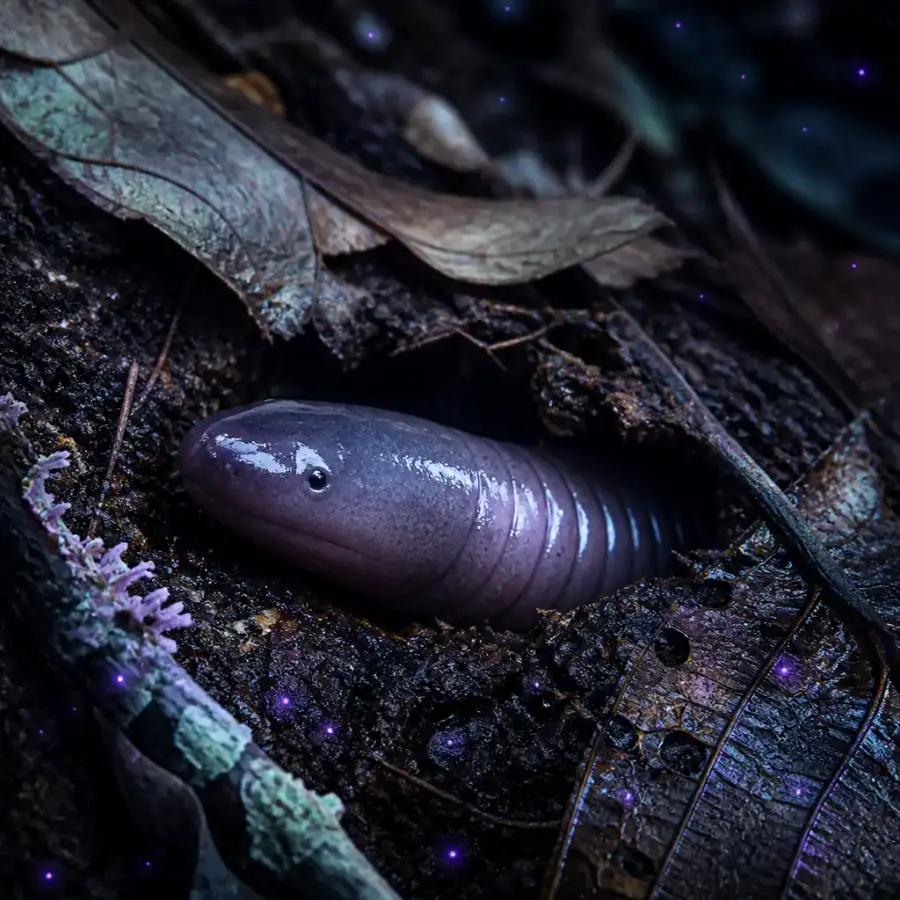
Caecilians are perhaps the ultimate hidden creatures, living predominantly underground, with reduced eyes that limit their vision, relying instead on specialized sensory organs on their heads. Their subterranean lifestyle makes them notoriously difficult for even seasoned researchers like Luís Felipe Toledo, a professor at Unicamp, to encounter in the wild, as he confessed to Agência FAPESP. Their morphological similarities across species further complicate identification, meaning many remain undescribed or misclassified for decades, even centuries.
This is where modern science truly shines. The discovery of Siphonops maria was not a simple sighting but a painstaking process involving genetic analysis and high-resolution microtomography to differentiate it from look-alikes. Researchers, including Adriano Oliveira Maciel of the Museu Paraense Emilio Goeldi, carefully compared body rings, dentition, and even subtle cranial features from collected specimens—some dating back to 1902—to confirm it was a distinct lineage. This meticulous work underscores the critical role of advanced techniques in revealing the full scope of Earth's biodiversity, particularly for species that thrive out of sight. Moreover, the researchers hope that by associating this obscure amphibian with a name as popular as Maria, it will help popularize the animal itself, bringing more attention to these vital, yet often overlooked, components of our ecosystems.
The Shadow of Colonialism in Scientific Collections
Yet, the story of Siphonops maria also highlights a persistent challenge within global science: the legacy of colonial-era collection practices. While identifying the new species, researchers found tantalizing hints of two other potential caecilian species in other Brazilian states. However, the path to confirming these discoveries is obstructed by a lack of comparative samples. Crucially, a UK museum holds 19th-century specimens from the critical location of Porto Real, Rio de Janeiro—the type locality for Siphonops hardyi—but has denied Brazilian scientists authorization to extract tissue for modern DNA sequencing, as Toledo noted in Noveen.com.br.
This incident is not isolated; it points to a broader systemic issue where historical collections from the Global South, often obtained under questionable circumstances, remain inaccessible to the very nations seeking to understand their own biodiversity. We believe that this perpetuates an imbalance in scientific knowledge and capacity. True scientific collaboration and equity demand that institutions holding these historical treasures facilitate access, or even consider repatriation, to foster a more inclusive and comprehensive understanding of global biodiversity. The refusal to share even a tiny tissue sample underscores a need for a profound shift in how international scientific institutions interact with nations whose natural heritage they curate.
The naming of Siphonops maria is a testament to the fact that science is not merely about classification, but about connection: connecting species to ecosystems, present discoveries to past labors, and names to narratives that deserve to be heard. It is a powerful example of how scientific recognition can serve as an act of historical justice, underscoring the deep, often unacknowledged, links between human history and environmental stewardship. This small, blind amphibian now carries a name that represents not just a species, but a rallying call for re-evaluating our past and fostering a more equitable scientific future.
No topics yet: start the first one.
More stories
Patagonian Yeast: A New Chapter in Evolution's Story
Recent findings from Chilean scientists in Patagonian wild yeast challenge conventional views on adaptation, suggesting evolution is more complex and dynamic than previously thought.

Argentina's Deep-Sea Secrets Demand Urgent Ocean Protection
The discovery of 57 new deep-sea species in Argentina's Mar del Plata canyon dramatically underscores the urgent need for continued marine exploration and robust conservation efforts.