Molecular Fingerprints: Gold Nanogap Sensor Redefines Search for Alien Life
A groundbreaking electrical nanogap sensor, developed by Osaka University, promises to revolutionize astrobiology by accurately distinguishing the chiral forms of amino acids, offering a robust method to detect life's unique molecular signature.
AI-generated image
Could the key to finding alien life not lie in complex structures or atmospheric compositions, but in the subtle twist of a molecule? For decades, the search for extraterrestrial life has often focused on environments conducive to water or the presence of gases thought to be biosignatures. But what if we've been looking for the wrong kind of evidence, or at least, not the most fundamental? A recent development out of the University of Osaka suggests a shift in focus, proposing an electrical method that could redefine how we hunt for alien biochemistry.
Published in Nature Communications, this exciting research describes a novel nanogap sensor that uses gold nanowires and artificial intelligence to electrically differentiate between the mirror-image forms of amino acids. This isn't just a technical marvel; it's a profound conceptual leap for astrobiology. By distinguishing between L- and D-forms of these fundamental building blocks of life with over 80% accuracy, the University of Osaka researchers, led by Takahito Oshiro and Masateru Taniguchi, have tapped into what many consider life's most intimate molecular fingerprint.
Chirality: Life's Unique Handedness
The concept of chirality, or "handedness," refers to molecules that are non-superimposable mirror images of each other, much like our left and right hands. For amino acids, the fundamental building blocks of proteins, this distinction is profound. Living organisms on Earth almost exclusively utilize L-form amino acids, while sugars, another vital class of biomolecules, tend to be found in their D-form. In stark contrast, nonliving chemical and physical processes typically produce both L- and D-forms in approximately equal abundance. This distinct L/D ratio of amino acids is therefore considered a powerful biosignature – a unique molecular fingerprint that hints at the presence of life,.
Traditionally, identifying these amino acid forms in astrobiological samples has involved methods that measure large groups of molecules, often requiring complex chemical reagents and being sensitive to environmental vibrations. These limitations pose significant practical challenges for space missions where compact, robust, and reagent-free detection is paramount. The Osaka team's electrical method offers a compelling solution, leveraging recent advancements in nanotechnology to overcome these hurdles.
Nanogap: A New Window into Molecular Life
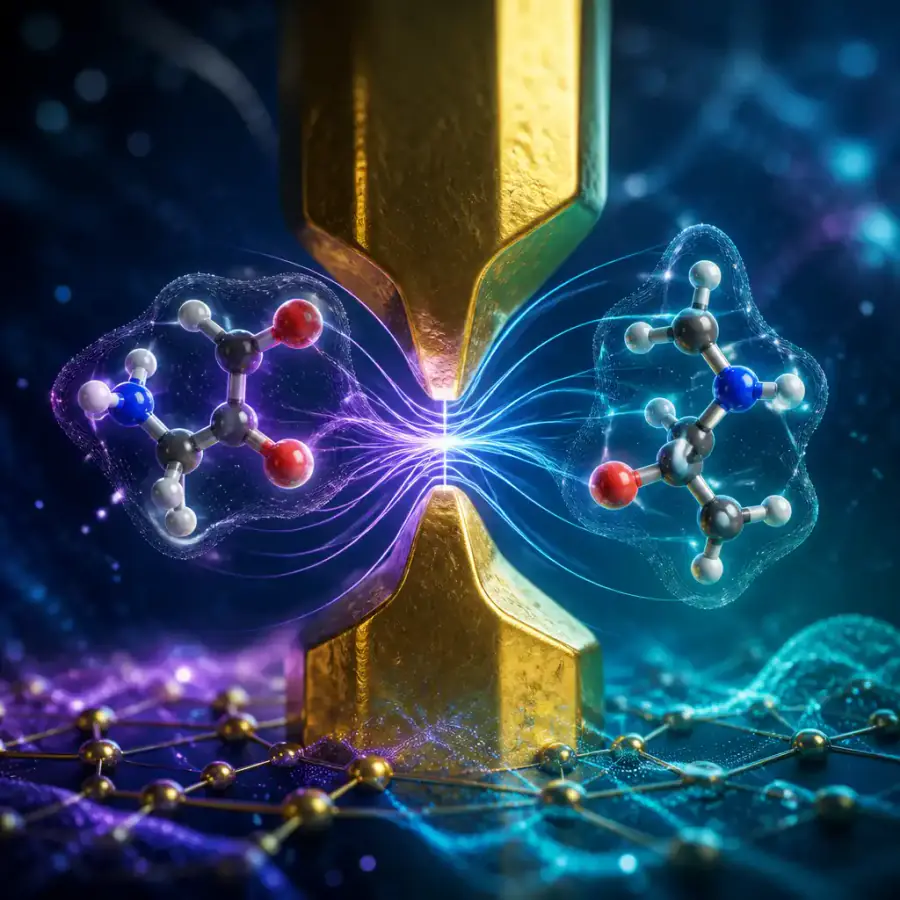
The core of this innovation lies in the use of nanogap tunneling. Molecules are guided to pass through an incredibly small gap between two gold nanowires. As each molecule traverses this gap, it generates an electrical tunneling current. Crucially, the current waveforms produced by L-form amino acids are distinctly different from those produced by D-form amino acids. This allows the system to directly count and differentiate between individual molecules, achieving an impressive accuracy of over 80% in distinguishing L- and D-forms, as lead author Takahito Oshiro noted,.
The researchers didn't stop at pure samples; they tested their technique on complex natural extracts relevant to astrobiology. Samples from the Murchison meteorite in Australia, known for its rich organic content, and soil from the extreme environment of the Atacama Desert in Chile were analyzed. The results demonstrated that their method was comparable to traditional techniques in identifying the major features of amino acid composition within these challenging mixtures. This validation in real-world samples underscores the potential of this technology to provide robust data from extraterrestrial environments.
This development is significant because it opens the door for creating compact, electrically based instruments capable of being deployed on future space missions. Imagine a small device, perhaps on a rover or probe, that can autonomously and precisely detect the chiral signatures of amino acids, offering irrefutable evidence for the presence of life's molecular machinery. This shift from bulk analysis to single-molecule discrimination, powered by nanotechnology and AI, represents a fundamental advance in chemical sensing and a thrilling prospect for the search for life beyond Earth.
No topics yet: start the first one.
More stories
Beyond the Splashdown: Crew-12's Lasting Blueprint for Space Endurance
The successful 237-day mission of NASA's Crew-12 underscores that true space exploration is less about the spectacle and more about the quiet, sustained dedication to scientific advancement in orbit.

Cosmic Collisions: How Black Holes Redraw Galactic Maps
Recent discoveries of unusual galaxies, shaped by ancient collisions, reveal supermassive black holes are not just passive inhabitants but active forces dictating galactic evolution.
Space's 'Rocket Revolution' Demands a Sustainability Reckoning
The surge in commercial spaceflight, celebrated during World Space Week, highlights an urgent need for global cooperation on orbital debris and long-term sustainability.
Neutrino Astronomy's Nobel: A New Universe Unveiled in Antarctic Ice
Francis Halzen's pioneering vision for the IceCube Neutrino Observatory has transformed our cosmic perception, opening an entirely new window into the universe's most violent and enigmatic phenomena.