The Virtual Cell: A Revolution, or a Giant Leap for Big Tech's Data Trove?
The $300 million investment in Biohub's virtual cell project signals a new frontier for AI in biology, but its true impact hinges on predictive accuracy and equitable access to its vast datasets.
AI-generated image
Can artificial intelligence truly unlock the deepest secrets of life, transforming how we understand and combat disease? This is the tantalizing promise behind a massive new initiative to create a "virtual cell," backed by some of the biggest names in tech and government alike.
At the heart of this ambition is the Biohub, a nonprofit biomedical research organization founded by Mark Zuckerberg and Priscilla Chan. It recently secured a collective $300 million investment from Google DeepMind, Meta, and AI drug discovery startup Isomorphic Labs. This private funding is part of a larger $1.8 billion commitment to Biohub's Virtual Biology Initiative, an effort to build AI-ready datasets that could allow scientists to perform biological experiments digitally.
The initiative isn't just relying on tech giants. The US Department of Energy is set to invest over $500 million over five years, with the National Institutes of Health coordinating more than $500 million in existing federal datasets. Biohub itself committed $500 million in April 2026. The goal, as Alex Rives, Biohub’s head of science, stated, is to create a high-accuracy predictive model of the cell that could dramatically accelerate scientific discovery by enabling digital experimentation.
The Promise of Digital Biology and the Funding Landscape
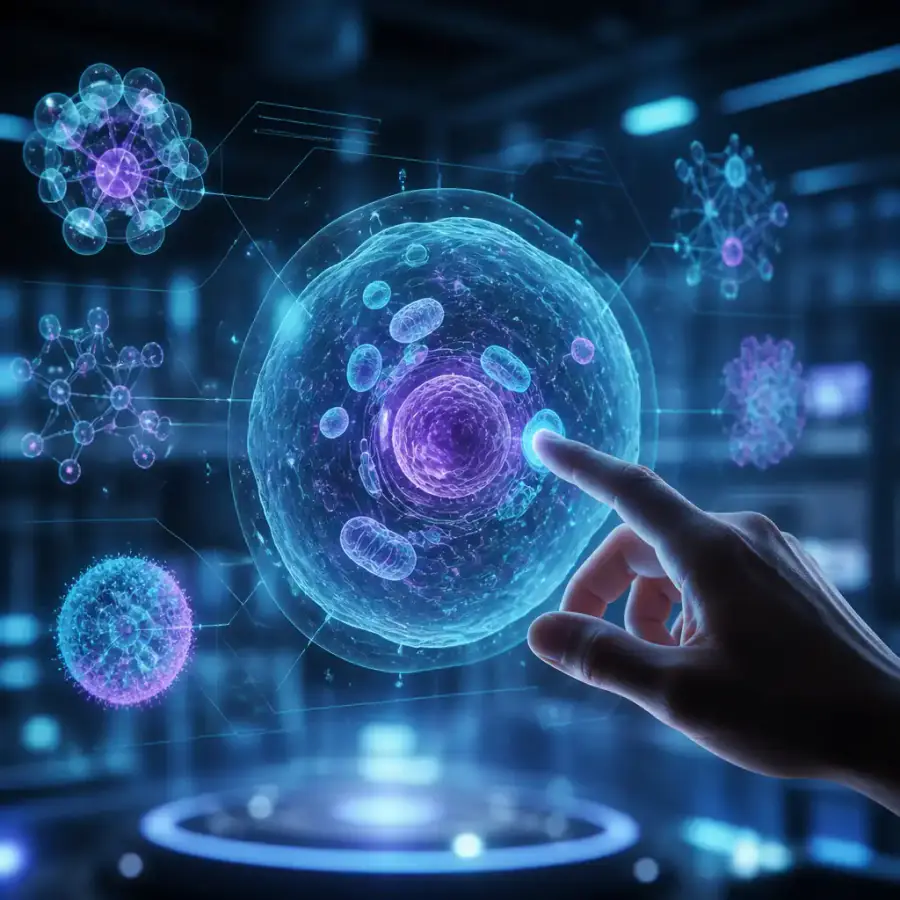
The prospect of a virtual cell is undeniably revolutionary. Imagine being able to simulate how a cell responds to a new drug or environmental change, not in a petri dish, but purely within a computational model. This could compress drug development timelines, which currently span years, and allow researchers to investigate biological questions digitally and select only the most promising experiments for laboratory testing, making scientific discovery vastly more efficient.
Achieving this vision requires an unprecedented amount of biological data. Current cell datasets typically cover hundreds of millions of cells, but an accurate predictive model will demand billions, and eventually trillions, of cells. Biohub's mission is to close this substantial data gap by measuring how cells respond across far more conditions than scientists have ever studied. This data will be collected using advanced techniques like spatial transcriptomics, which maps molecular activity inside intact tissue, and various screens that record cellular responses. Much of this data has never been generated in such a coordinated and standardized way, which is crucial for training effective AI models.
Early Access and the Long Road Ahead
While the promise of a virtual cell is immense, the initiative also highlights a complex interplay between open science and commercial interests. The datasets generated will eventually be made public, but commercial funders like Google DeepMind, Meta, and Isomorphic Labs will receive a one-year embargo period on the data they help generate. This exclusive early access provides a critical head start for training their own models before the data becomes a public scientific resource. In contrast, government-funded work within the initiative will carry no such restrictions, ensuring immediate public availability of that specific data.
For companies like Isomorphic Labs, which focuses on AI-driven drug discovery, this early access is particularly valuable, potentially feeding directly into their business of developing drug candidates. However, the $300 million collective investment from these tech giants represents a relatively small sum compared to their colossal annual R&D budgets—less than a single day of their combined spending. This suggests that for Alphabet and Meta, their involvement is a
No topics yet: start the first one.
More stories
Jonathan the Tortoise Isn't Just Old: His Genes Redefine Aging
A new *Science Advances* study on Jonathan, the 194-year-old Aldabra giant tortoise, reveals localized genetic stability that challenges our understanding of biological aging and offers crucial clues for human longevity.
Rosalind Franklin's Legacy: Why History Must Acknowledge Her Full Vision
A re-examination of Rosalind Franklin's scientific output, including her detailed notes and reports, confirms her profound understanding of DNA's helical structure, reinforcing the necessity of a fully accurate historical account.
Chirality: How Molecular 'Hands' Reshaped Drug Discovery
The 2026 Nobel Prize in Chemistry celebrates Henri Kagan and Kenso Soai's groundbreaking work, finally taming the elusive mirror-image nature of molecules to revolutionize medicine.

Siberia's Plague Lab Death: A Biosecurity Wake-Up Call
The suspicious death of a researcher in an anti-plague laboratory in Irkutsk, coupled with conflicting official reports, underscores the critical need for absolute transparency and rigorous safety protocols in pathogen research globally.