Rosalind Franklin's Legacy: Why History Must Acknowledge Her Full Vision
A re-examination of Rosalind Franklin's scientific output, including her detailed notes and reports, confirms her profound understanding of DNA's helical structure, reinforcing the necessity of a fully accurate historical account.
AI-generated image
The history of science, particularly its triumphant moments, often features narratives curated by those who receive the accolades. In the monumental discovery of the DNA double helix, the story of Rosalind Franklin has long been painted as that of a brilliant, meticulous technician whose crucial data was instrumental, yet whose interpretive genius was supposedly incomplete. We believe this narrative is not only unfair but inaccurate. A deeper historical analysis of Franklin's work, including her detailed notes and unpublished reports, strongly indicates that she not only provided the key evidence but also recognized the helical structure of DNA before Watson and Crick's breakthrough.
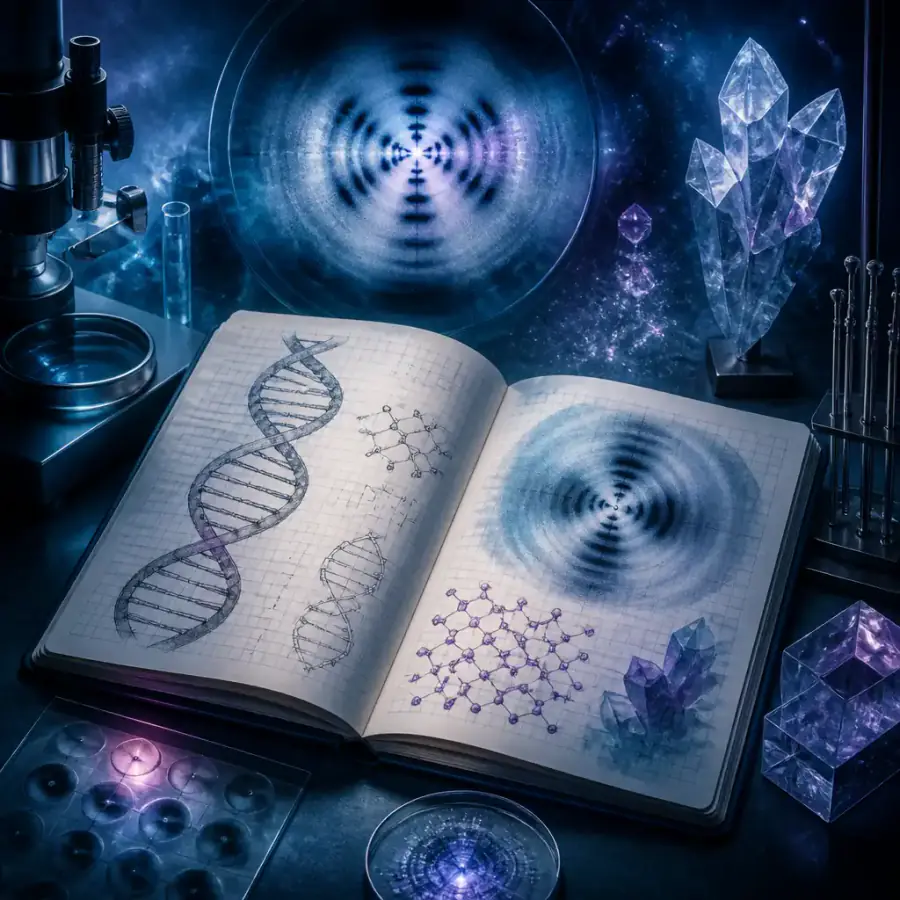
Rosalind Franklin, an English chemist and X-ray crystallographer, made groundbreaking contributions to the understanding of molecular structures, including DNA, RNA, and viruses. While her work on coal and viruses was appreciated in her lifetime, her pivotal role in elucidating the structure of DNA was largely unrecognized, earning her monikers like the "wronged heroine" and the "dark lady of DNA" (as described by Wikipedia). It was her mastery of X-ray diffraction, honed during her time in Paris, that guided the crucial work leading to the now-famous Photo 51. This image, taken by her student Raymond Gosling in 1952 using her developed technique at King's College London, revealed an elegant, symmetrical pattern that was key to understanding DNA's structure.
Famously, Maurice Wilkins, her colleague, showed Photo 51 to James Watson without Franklin's permission. Watson later recalled his pulse quickening upon seeing it (as reported by DPMA). Along with an unpublished research report of Franklin's, also shared without her knowledge by Max Perutz, this data became the foundation for James Watson and Francis Crick's 1953 model of the double helix. For this discovery, Watson, Crick, and Wilkins received the Nobel Prize in Physiology or Medicine in 1962. Franklin, having died in 1958 at age 37, was ineligible for the posthumous award, but her foundational work was central to their breakthrough. We contend that the full scope of her intellectual contribution, however, has been consistently undervalued.
Beyond the Data: Franklin's True Vision
The initial narrative often downplayed Franklin's interpretive genius, suggesting she was merely a meticulous technician who produced critical data without fully grasping its meaning. However, a thorough analysis of Franklin's extant work, including her detailed notes and reports, effectively dismantles this caricature. It wasn't just that her Photo 51 vividly demonstrated the double helix, but her meticulous calculations and scientific reasoning point to an advanced conceptual understanding. She meticulously documented the two forms of DNA (A and B), the precise measurements, and the implications of the B-form's X-ray diffraction pattern, which was undeniably helical. We see her not just as a data generator but as a theorist in her own right, building a robust case for the helical structure through rigorous experimentation and analysis.
The Lingering Shadows of Unfairness
The story of Rosalind Franklin is a stark reminder of the challenges faced by women in science, particularly in mid-20th-century academia. While her peers received immediate and enduring recognition, Franklin's contributions were largely unacknowledged in her lifetime and, in our view, deliberately obscured by some. The environment at King's College London, described as less than collegial to female scientists, created obstacles for her, forcing her to work in isolation. The sharing of her data without her consent, both Photo 51 and her research report, represents a profound ethical lapse that undoubtedly accelerated Watson and Crick's discovery while sidelining her. This sequence of events, in our analysis, amounts to a clear instance of intellectual appropriation that delayed proper recognition for decades. It is a disservice to her legacy to view her solely as a provider of images, rather than as a co-discoverer in spirit, whose independent intellectual journey led her to the same fundamental truth.
Rectifying the Historical Record
For too long, Franklin's role has been relegated to that of a supporting character. Yet, the consensus among historians of science is growing: her contribution was not merely instrumental; it was foundational and intellectually complete. We believe that by understanding the depth of her insights, we move closer to a more honest and equitable portrayal of one of science's most celebrated moments. Recognizing Franklin's full scientific stature—her experimental prowess, her analytical rigor, and her conceptual understanding—is not about diminishing the achievements of Watson, Crick, and Wilkins, but about ensuring that the true complexity and collaborative, often fraught, nature of scientific discovery is accurately represented. It is time to fully write Rosalind Franklin into the pantheon of scientific giants, not just as a wronged heroine, but as a visionary who saw the secret of life unfolding through her own work.
No topics yet: start the first one.
More stories
Jonathan the Tortoise Isn't Just Old: His Genes Redefine Aging
A new *Science Advances* study on Jonathan, the 194-year-old Aldabra giant tortoise, reveals localized genetic stability that challenges our understanding of biological aging and offers crucial clues for human longevity.
The Virtual Cell: A Revolution, or a Giant Leap for Big Tech's Data Trove?
The $300 million investment in Biohub's virtual cell project signals a new frontier for AI in biology, but its true impact hinges on predictive accuracy and equitable access to its vast datasets.
Chirality: How Molecular 'Hands' Reshaped Drug Discovery
The 2026 Nobel Prize in Chemistry celebrates Henri Kagan and Kenso Soai's groundbreaking work, finally taming the elusive mirror-image nature of molecules to revolutionize medicine.

Siberia's Plague Lab Death: A Biosecurity Wake-Up Call
The suspicious death of a researcher in an anti-plague laboratory in Irkutsk, coupled with conflicting official reports, underscores the critical need for absolute transparency and rigorous safety protocols in pathogen research globally.