NASA's Tri-Fold Strategy: How Curiosity, ISS, and Artemis Propel Discovery
NASA's latest achievements, spanning Curiosity's Martian vistas, successful ISS crew returns, and significant Artemis III progress, reveal its unparalleled ability to drive scientific discovery and human deep-space exploration.
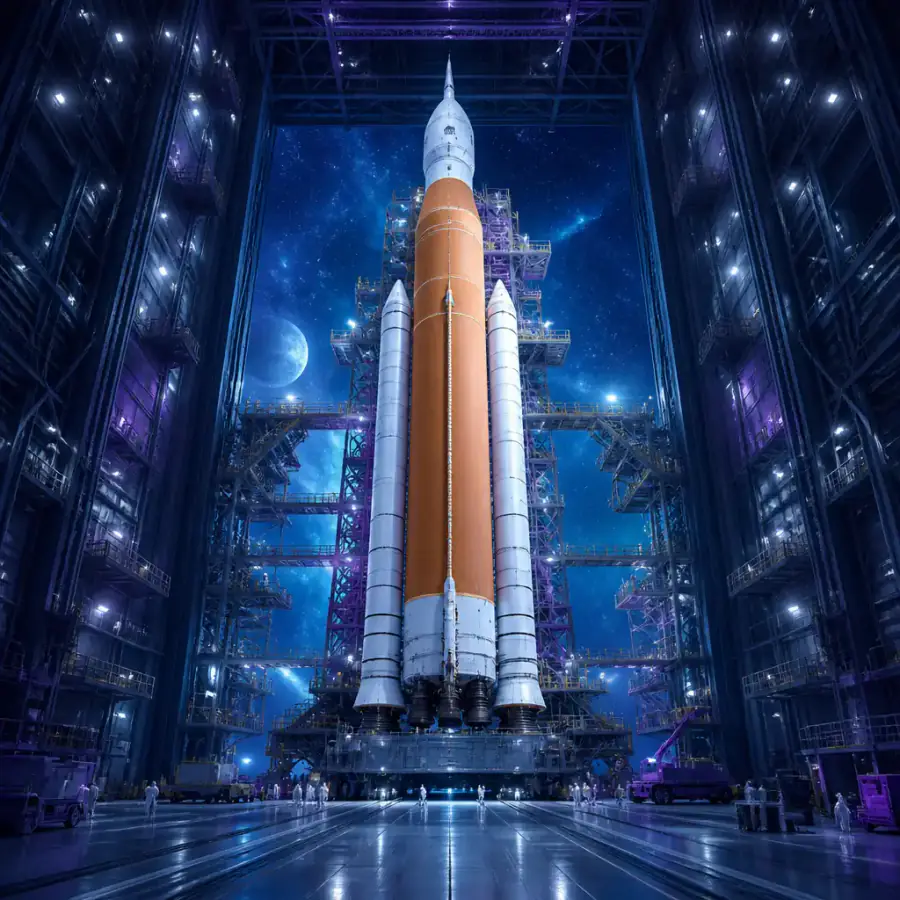
AI-generated image
What does it mean for a space agency to be truly at the forefront of exploration and scientific discovery? It means not just pursuing a single grand vision, but simultaneously advancing on multiple, disparate fronts, each demanding unique expertise and offering distinct rewards. This past week, NASA has offered a compelling illustration of this multi-faceted commitment, delivering headlines that span the poetic beauty of planetary science, the critical logistics of human spaceflight, and the ambitious preparations for our return to the Moon.
From a breathtaking image of Martian dawn captured by a seasoned rover to the safe splashdown of astronauts after months in orbit, and the steady assembly of a rocket destined for lunar exploration, the agency has demonstrated its expansive reach. We've seen a vivid snapshot of another world, witnessed the seamless operational cadence of the International Space Station, and gotten a tangible glimpse of the next steps towards establishing a sustained human presence beyond Earth. It's a testament to an organization that refuses to stand still, pushing boundaries across the solar system and just above our heads.
Martian Artistry Meets Geologic Clues
The enduring mission of the Curiosity rover on Mars continues to yield both scientific insights and astonishing visuals. This week, NASA released a striking panorama captured by Curiosity on August 11, 2026, showcasing a Martian dawn illuminating wind-carved crags known as yardangs. The image, processed without white balancing, offers an unvarnished view of the early morning light bathing jagged geological features as Astrobiology reports. This isn't merely a pretty picture; it’s a crucial data point for scientists eager to understand the formation of these ancient cliffs, providing clues about Mars's geological and possibly even volcanic history. In our view, these images serve a dual purpose: they engage the public, reminding us of the alien beauty beyond Earth, while simultaneously providing invaluable information to decipher the Red Planet's deep past. The longevity of Curiosity, whose panorama was captured on its 4,982nd Martian day, is itself a remarkable engineering feat, allowing for such prolonged, detailed observation.
The Quiet Triumph of Routine Returns
While Martian dawns captivate, the mechanics of bringing humans safely home are equally, if not more, critical. This week, the four astronauts of SpaceX’s Crew-12 mission undocked from the International Space Station (ISS) on October 7, targeting a splashdown off the coast of California on October 8. After nearly eight months in space, astronauts Jessica Meir and Jack Hathaway of NASA, Sophie Adenot of ESA, and Andrey Fedyaev of Roscosmos completed a mission that included numerous scientific experiments and even historic spacewalks, such as Adenot becoming the first French woman to walk in space as Space.com details. Their return, following the arrival of Crew-13 on October 1, highlights the sophisticated choreography of ISS operations and the robust nature of commercial crew transport. We believe this seamless transition is a quiet triumph, demonstrating the maturation of low-Earth orbit access and the vital international collaboration that underpins the station's success. It shows that even as we dream of distant worlds, the essential work of maintaining our orbital outpost continues with impressive reliability.
Laying the Groundwork for Lunar Footprints
Looking further afield, NASA is making significant strides in its Artemis program, particularly with preparations for Artemis III. The massive core stage of the Space Launch System (SLS) rocket, the backbone of future lunar missions, arrived at Kennedy Space Center in April 2026. This 212-foot-long component, along with booster segments and RS-25 engines, is being integrated in the Vehicle Assembly Building according to NASA. Artemis III, targeted for 2027, aims to test crucial rendezvous and docking capabilities between the Orion spacecraft and commercial lunar landers in low Earth orbit, setting the stage for human landings on the Moon during Artemis IV in 2028 as ABC News reports. This meticulous assembly work, combining new technology with upgraded space shuttle hardware, underscores the immense engineering challenge and the long-term vision behind returning humanity to the lunar surface. The sheer scale and complexity involved confirm our view that these missions are not just about reaching a destination, but about building the infrastructure and refining the techniques for a sustained presence in deep space.
NASA's recent activities paint a picture of an agency operating on all cylinders, effectively managing ongoing scientific probes, ensuring the safety of its astronauts, and methodically building towards the next great leaps in human exploration. From the serene, wind-swept vistas of Mars to the bustling preparations for a lunar future, these efforts demonstrate a dynamic and comprehensive commitment to pushing the boundaries of what is known and what is possible.
No topics yet: start the first one.
More stories
Beyond the Splashdown: Crew-12's Lasting Blueprint for Space Endurance
The successful 237-day mission of NASA's Crew-12 underscores that true space exploration is less about the spectacle and more about the quiet, sustained dedication to scientific advancement in orbit.

Cosmic Collisions: How Black Holes Redraw Galactic Maps
Recent discoveries of unusual galaxies, shaped by ancient collisions, reveal supermassive black holes are not just passive inhabitants but active forces dictating galactic evolution.

Molecular Fingerprints: Gold Nanogap Sensor Redefines Search for Alien Life
A groundbreaking electrical nanogap sensor, developed by Osaka University, promises to revolutionize astrobiology by accurately distinguishing the chiral forms of amino acids, offering a robust method to detect life's unique molecular signature.

Space's 'Rocket Revolution' Demands a Sustainability Reckoning
The surge in commercial spaceflight, celebrated during World Space Week, highlights an urgent need for global cooperation on orbital debris and long-term sustainability.