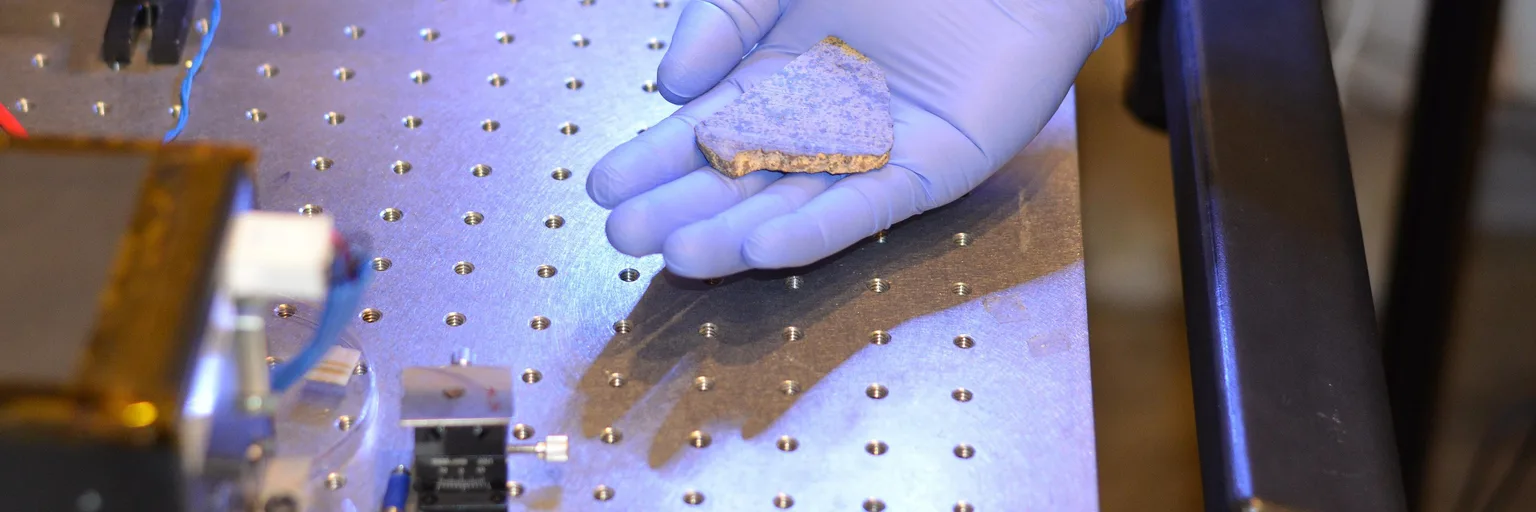
Martian dust is a lung problem, and we should fund toxicology now
Perseverance measured dust grains of about 100 nanometers over 1,645 sols. Protecting astronauts' lungs is a design problem as serious as the rocket, and it needs money today.
Photo: NASA/JPL-Caltech/University of Arizona / Wikimedia Commons (Public domain)
We spend most of our Mars daydreams on rockets: bigger, reusable, faster. Yet the first thing to get into an astronaut's body on the Red Planet may not be radiation or a failed landing, but something far less cinematic: dust. A very, very fine dust.
Here is what the reporting says. Perseverance has measured Martian dust for 1,645 sols, a little over four and a half Earth years, and Merca2 reports that the result was published in Proceedings of the National Academy of Sciences. The rover, which works in and around Jezero crater, detected particles of about 100 nanometers across, which La Jornada describes as the finest dust recorded on Mars to date. The coverage also says the finest grains cling to spacesuit material samples and that some could reach the lungs and the bloodstream.
The finding is real, but the health verdict is still missing
Let's be careful, because some headlines have not been. Some outlets describe the dust as toxic to humans. The documentation we have does not support that. One of the reports, Ahora Digital, notes that on Earth particles of this size are a concern because they can get deep into the lungs and, depending on their traits, reach the blood. It also says the specific effects of Martian dust on human health still need study.
That is the honest summary: we know the size, and we know size matters. We do not know the dose, the chemistry in a living lung, or how long exposure would take to cause harm. Measuring a grain is physics. Knowing what it does inside a person is toxicology, and that is the part we are missing.
Rockets get the budget; lungs get the footnote
In our view, this is the real story. Space agencies are very good at funding what can be built and launched. A hardware problem has a schedule and a supplier. A toxicology question has neither, and it quietly slips down the list until someone is already living with the answer.
The pattern is easy to guess. Crews come in from the surface, the dust comes in with them, and a small habitat has no open window to air it out. That is our extrapolation, not a result from the study. It is also why we think the dust belongs in the core design of airlocks, suits and cabin air, not in a late-stage safety review.
Notice, too, what is on the NASA agenda right now. 20minutos reports that Google and NASA are testing a prototype robot to assist astronauts on future Mars trips, in a context where a round-trip communication delay could reach 44 minutes and make real-time medical assistance harder. The stated long-term goal is a robot that could help with routine health checks, such as basic vital signs, under a crew physician's supervision. That is a useful tool. But a helper that might one day take vital signs does not prevent a chronic lung injury. When a round trip to a doctor on Earth can take 44 minutes, prevention is worth much more than treatment.
What we would fund, and what we would not claim
We would put money into three things before any crew is named:
- Lab studies of lung and blood effects using realistic Martian dust simulants, built from the measured particle sizes.
- Suit and airlock tests aimed at keeping the finest grains out of the cabin.
- Exposure limits for Mars that are set from evidence, not borrowed by analogy.
We would not claim that Mars is poisonous, or that crewed missions are doomed. One study, however long its dataset, does not settle that. It could turn out that the dust is a manageable nuisance. But "could turn out fine" is a bad foundation for a mission where nobody can pop home for treatment.
The verdict: the cheapest time to learn how dangerous Martian dust is, is before anyone breathes it. Fund dust toxicology now, treat the lungs as part of the vehicle, and stop thinking of health protection as a supporting act to the rocket.
No topics yet: start the first one.
More stories
A dead star's double ring says planets outlive their suns, not our fate
Two rings of debris around white dwarf WD J1328−1450 show planetary systems can survive stellar death. It's a vivid preview of our future, but one system is not a forecast.

A Saharan rock from Mars shows what free samples can tell us
Teghaza 001, a meteorite at least 4.1 billion years old, hints at a wetter early Mars. It also shows why a lucky find from the desert needs careful, modest reading.
Betelgeuse calming down isn't an anticlimax: quiet is data too
After months of fading, the red supergiant has stopped sinking, for now. That's no letdown: each wobble of Betelgeuse is teaching us how little we knew about stars near the end of their lives.
Teghaza 001 is a free Mars sample, and a reason to want more
A 4.1-billion-year-old rock from the Sahara shows how much meteorites can teach us about early Mars, and why that is an argument for sample return, not against it.