Avian Minds: Body Awareness in Cockatoos Reshapes Self-Perception
Recent research on Goffin's cockatoos demonstrating body awareness in obstacle tasks suggests a more complex form of self-perception in birds than previously assumed, reshaping our understanding of animal cognition.
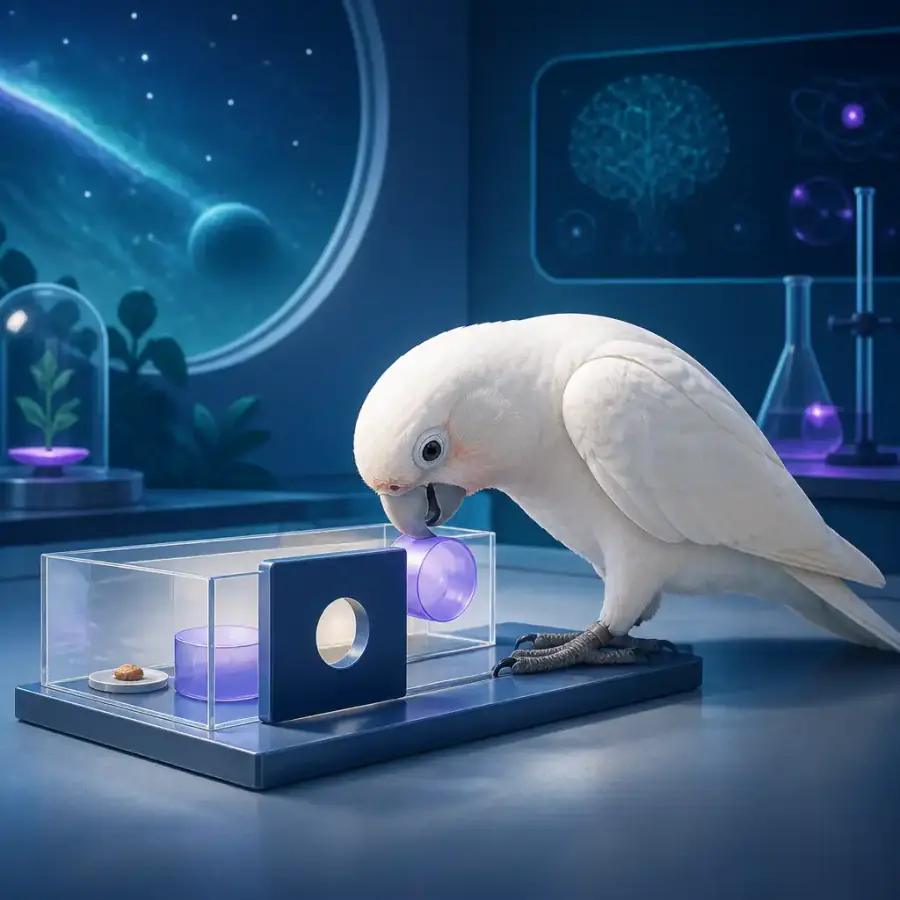
AI-generated image
Are we alone in our capacity for self-awareness, or is the animal kingdom far more introspective than we have traditionally believed? For decades, our understanding of self-perception in animals has largely hinged on the mirror self-recognition test, a benchmark that often left many species, birds included, outside the exclusive club of 'self-aware' beings. However, recent findings on Goffin's cockatoos are now compelling us to rethink these narrow definitions and expand our view of what self-perception truly entails.
A groundbreaking study, hypothesized in Nature in 2026 by P. Hundegger and his team, put the cognitive abilities of Goffin's cockatoos to a unique test. The intriguing premise: could these intelligent birds treat their own bodies as causal obstacles to completing a task? The answer, as detailed in a press release from Vetmeduni.ac.at on September 18, 2026, and echoed by enigmania.blog the day before, appears to be a resounding yes. The research demonstrates that when their own bodies physically impede them from reaching a goal, Goffin's cockatoos exhibit a clear understanding of their body's presence and its role as an obstacle, providing compelling evidence of what scientists term body awareness.
Beyond the Mirror: A New Dimension of Self-Perception
This discovery is profoundly significant because it expands the conventional wisdom about what constitutes self-perception beyond mere visual recognition. While the mirror test focuses on recognizing oneself visually, body awareness delves into a deeper, proprioceptive understanding of one's physical self in space and its interaction with the environment. It implies an internal model of the body, allowing an animal to understand its physical dimensions and limitations dynamically. In our view, this form of awareness offers a more fundamental insight into an organism's cognitive map of itself, suggesting a nuanced self-concept that doesn't rely solely on visual cues. It's a foundational step that could contribute to broader self-awareness.
Historically, complex cognitive traits like self-awareness have often been attributed predominantly to primates or a select few mammals. However, the Goffin's cockatoo, a parrot species native to the Tanimbar Islands in Indonesia, is now pushing the boundaries of these anthropocentric views. Their performance in this 'body-as-obstacle' task indicates a level of cognitive sophistication that demands our attention and warrants a broader comparison of avian problem solving within the larger context of cognition and intelligence, as highlighted by Jove.com. It’s a powerful reminder that intelligence manifests in diverse ways across the tree of life, not just along familiar evolutionary paths.
Avian Brains: A Compact Powerhouse of Cognition
The idea that birds possess advanced cognitive abilities is not entirely new. Over the past decade, a growing body of research has consistently highlighted the remarkable intelligence of various avian species. As CORDIS reported in 2016, researchers have suggested that avian brains might possess a significantly higher cognitive power per unit of mass, owing to their densely packed neurons. This neurological architecture seems to underpin an impressive array of skills observed in birds like the Goffin's cockatoo, making the phrase 'birdbrained' less of an insult and more a testament to their cognitive efficiency.
These birds have already impressed scientists with their remarkable cognitive toolkit. Prior studies have revealed their ability to solve complex mechanical problems, use and even manufacture tools, sometimes demonstrating the entire behavioral sequence instantly, as documented in Current Biology01111-8) and reported by Sci.News. For example, research from 2021 by B. Wakonig and colleagues documented their adeptness at string-pulling, a task requiring sequential problem-solving. They can also differentiate objects based on weight cues. This new evidence of body awareness fits seamlessly into this emerging picture of avian intelligence, further cementing the notion that our understanding of animal consciousness is still in its nascent stages. As Quo.eldiario.es theorized in 2020, such brain structures could potentially lead to self-awareness.
What This Means for Our Understanding of Consciousness
The findings on Goffin's cockatoos compel us to reconsider the exclusivity of advanced cognitive traits. If a species as evolutionarily distant as a parrot can exhibit body awareness, it suggests that the building blocks of complex self-perception may be more widespread across the animal kingdom than previously thought. This challenges the anthropocentric bias in cognitive science and opens doors to investigating similar capacities in other species, potentially even those we consider less 'intelligent'.
For us, this research is not merely about cockatoos; it's about shifting our paradigm. It pushes us to acknowledge that consciousness and self-perception exist on a spectrum, manifested in diverse forms adapted to each species' ecological niche. The ability to recognize one's body as a causal agent is a crucial step towards a more comprehensive self-concept. It invites us to be more humble in our definitions of intelligence and self-awareness, fostering a deeper appreciation for the rich inner lives that animals, including our feathered friends, might possess. Perhaps it’s time to move beyond the mirror and explore the intricate worlds within avian minds.
No topics yet: start the first one.
More stories
The Diagnostic Maze: Why ADHD, Autism, and Trauma Demand Deeper Insight
The significant overlap in behavioral expressions across ADHD, autism, and complex trauma highlights an urgent need for precise diagnostic methods to ensure individuals receive appropriate and effective support.