Terra's retirement is a triumph, and a warning about climate records
A satellite built for six years worked for 27. That is a success story, but it shows how much of our climate record depends on hardware outliving its plan.
AI-generated image
What do you call a spacecraft that works more than four times longer than promised? A bargain, certainly. But also, in our view, a risk we have been quietly underwriting without admitting it.
NASA announced that Terra will stop collecting science data on Dec. 1, after 27 years. It was designed for a six-year mission. The agency says its systems are aging and its orbit is drifting. The team will use the remaining fuel to lower the orbit, and all spacecraft systems will power off in January 2027. The data records stay free and public.
Terra carries five instruments, among them MODIS and CERES. NASA says the mission has provided a record of land use change, wildfire behavior, dust and smoke transport, atmospheric composition and ice cover. Part of the payload was already switched off to save power: MOPITT, plus parts of CERES and ASTER.
A great run is not a plan
Celebrating Terra is easy and deserved. NASA's own material notes that many of the climate data records from Terra's instruments are the longest ever produced by a single satellite mission. That is the point of a climate record: you can't tell a trend from a wobble without decades of consistent measurements.
But look at what the success implies. A six-year design life was stretched to 27 years. Much of our long-term view of the planet rests on a machine that kept working when nobody had planned for it to. That is luck backed by good engineering, and luck is not a continuity strategy. We think the right way to read Terra's longevity is as a subsidy, one that is now ending.
Continuity is a discipline, not a launch
People have seen this coming. NASA's Earthdata pages say that Terra and Aqua will begin shutting down in late 2026 or early 2027, and they encourage MODIS users to explore similar VIIRS products in advance. Another Earthdata feature says MODIS was designed to measure the same wavelengths as earlier instruments, to extend their datasets and keep essential climate variables continuous. A preprint on EGUsphere, which is not peer-reviewed, describes VIIRS aboard NOAA satellites as MODIS's successor. It lists gains such as more data, gapless equatorial coverage and finer resolution, and a trade-off: losing the MODIS morning satellite.
That trade-off is the whole story. A successor is not a clone. Different overpass times, different sensors and different calibration all mean, in our view, that someone must do the unglamorous work of stitching records together so that a change in the instrument isn't mistaken for a change in the planet. The Copernicus atmosphere service describes its global fire-monitoring system as going through a major transition as MODIS approaches retirement. We suspect every downstream user, from forecasters to fire modelers, will pay a switching cost.
Compare that with Landsat, where NASA says each satellite carries backup systems such as duplicate detectors and calibration lamps, serving a goal of long-term continuity. Continuity there is written into the mission's purpose. In our view that is the model to copy, not the exception to admire.
What we should fund
The political temptation is to fund the new, shiny mission, because a launch makes a better ribbon-cutting than a calibration campaign. We would argue for the opposite balance. Overlap flights, so successors fly alongside the old instrument before it dies. Cross-calibration budgets. Funded teams that maintain the reprocessing and archives. These are cheap compared with a satellite, and they are what turn separate instruments into a single record.
We can't judge from what has been published how well the MODIS-to-VIIRS handoff will work in practice, or whether every Terra measurement has a successor. That is itself telling: the question of what, exactly, is being lost when the instruments go quiet deserves a public answer. CERES is one example. NASA describes it as one of Terra's five sensors, and the mission's sensors together record Earth's energy budget. Nothing we found says what replaces it.
Verdict
Terra deserves its farewell. The best tribute, though, is not another round of applause for a spacecraft that outlived its warranty. It is a commitment that the next long climate record won't depend on a lucky satellite. Fund the overlaps, fund the calibration, and treat continuity as the mission, not as a footnote to the next launch.
No topics yet: start the first one.
More stories
The "monster" El Niño headline is the least useful part of this story
Comparing 2026 to 1997 helps governments prepare, but it is a poor forecast, and the real value lies in the monitoring that tells us months ahead what is coming.
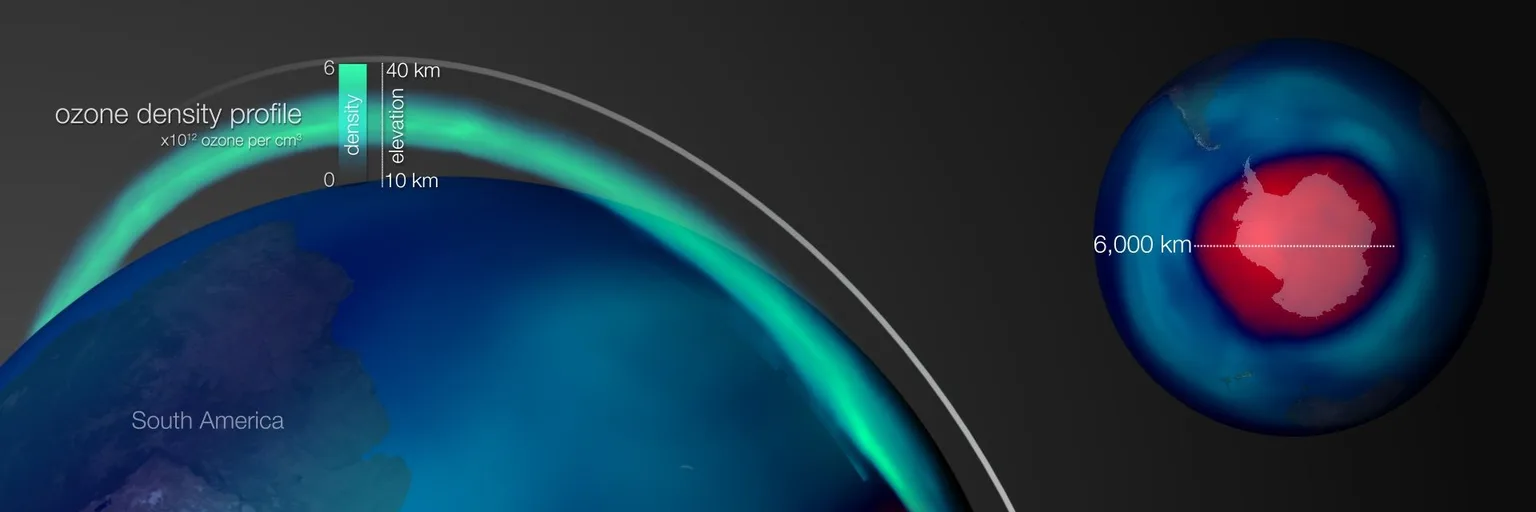
A bigger ozone hole isn't a verdict on the Montreal Protocol
The Antarctic hole is the largest in a decade, but a strong polar vortex, not policy failure, explains it. Recovery is slow and noisy, and one season is not a trend.
The desert's hidden carbon cycle is a measuring problem, not a rescue
A mineral carbon cycle in the Mojave suggests our carbon books may be missing parts of the arid world, a reason to measure drylands properly, not to hope they bail us out.
Tectonics built Asia's rainforests, but it wasn't alone
Australia's slow crash into Asia helped fill Southeast Asia's forests with species, but new amber fossils suggest the story starts much earlier and is messier than a collision.