Weather's Unyielding Grip: Why Spaceflight Still Bows to Earth's Whims
Despite advanced technology and reusable rockets, the Crew-12 mission's multiple launch delays and ongoing departure monitoring reveal how Earth's unpredictable weather remains a dominant force in space operations.
AI-generated image
In an era defined by reusable rockets, advanced spacecraft, and ambitious lunar and Martian aspirations, one might assume that humanity has largely mastered the elements of space travel. Yet, as the ongoing consideration of weather for SpaceX's Crew-12 mission vividly demonstrates, the simple, unpredictable forces of Earth's weather continue to exert a humbling, decisive influence on even the most sophisticated space operations.
Currently, NASA and SpaceX are monitoring weather conditions off the California coast as the Crew-12 spacecraft prepares to depart from the International Space Station (ISS). Unfavorable weather and splashdown conditions are key factors in determining the precise timing for undocking, as teams actively monitor the evolving meteorological picture, as NASA confirms. This careful monitoring highlights how meteorological factors remain a paramount, unyielding force dictating the delicate dance of spaceflight operations.
A Familiar Foe: Launch Delays in February 2026
This isn't the first time the Crew-12 mission has felt the undeniable hand of Mother Nature. Back in February 2026, the launch of Crew-12 itself was subject to multiple postponements. Originally planned for February 11th, its liftoff was pushed back not once, but twice, due to adverse weather conditions. NASA and SpaceX initially adjusted the launch date from February 11th to February 12th, and then again to February 13th. Spaceflight Now reported the delay until February 13th, and USA Today confirmed the mission was delayed twice due to poor weather.
The primary culprits for these initial delays were often high offshore winds in the ascent corridor, a critical area for the Falcon 9 rocket's trajectory. As FOX 35 Orlando noted, these elevated winds posed significant risks. This isn't unique to Crew-12; a similar scenario affected the SpaceX Crew-4 undocking in 2022, when a cold front brought high winds and rainy weather near the splashdown zones off Florida, as NASA reported. It illustrates a persistent challenge: no matter how powerful our rockets or how precise our navigation, the atmosphere remains the first and often most formidable obstacle.
More Than Just the Launchpad: The Whole Mission is Vulnerable
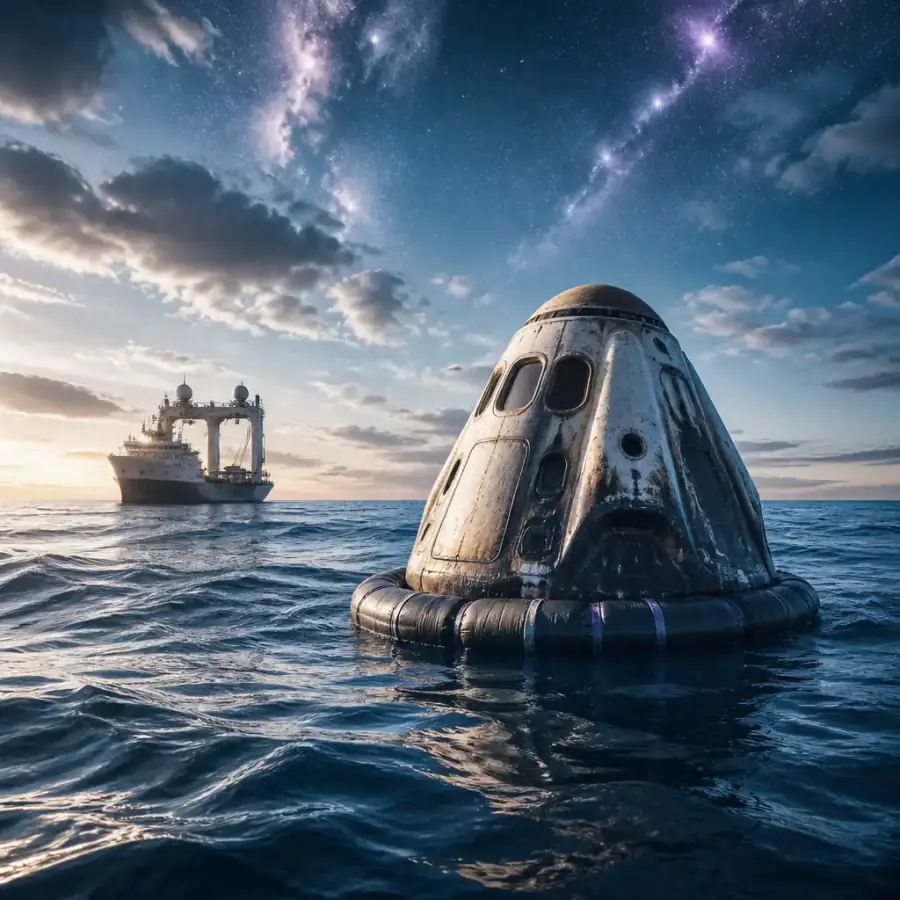
The public often focuses on launch windows, but the weather's influence extends to every phase of a crewed mission. For a launch, conditions must be clear not just at the launch site, but also along the ascent corridor to ensure safety and allow for potential abort scenarios. Then, during the journey, precise orbital mechanics are crucial, but even minor atmospheric drag variations can play a role. Finally, for an undocking and splashdown, the requirements become even more stringent, demanding calm seas, minimal winds, and clear skies in designated recovery zones.
This comprehensive vulnerability underscores the complexity. We might have engineered rockets to pierce the sky and modules to withstand the vacuum of space, but we still cannot control the clouds, the currents, or the squalls. Every delay, whether for launch or return, costs millions in operational expenses and puts additional strain on intricate logistical schedules and the crews themselves, who must remain at peak readiness for extended periods. It's a stark reminder that space travel is inherently a global endeavor, affected by weather patterns that span continents and oceans.
The Unwavering Power of Nature in the Age of Space Exploration
While space agencies like NASA and private partners like SpaceX employ sophisticated meteorological forecasting and leverage advanced models, the inherent unpredictability of Earth's weather systems means that delays are not just an inconvenience but a necessary safety protocol. The decision to scrub a launch or delay a return is never taken lightly; it prioritizes human life and mission integrity above all else. This conservative approach is a testament to the fact that, despite all our technological prowess, certain fundamental laws of nature, particularly those governing our planet's dynamic atmosphere, remain beyond our mastery.
In our view, the saga of Crew-12, from its initial launch delays to the careful planning for its current departure, serves as a powerful microcosm of humanity's ongoing relationship with the natural world. It reminds us that while we reach for the stars, our journey always begins and ends firmly rooted in the unpredictable embrace of Earth. Space exploration, therefore, is not just about conquering new frontiers, but about learning to harmonize our ambitions with the planet that cradles us.
No topics yet: start the first one.
More stories
McGetchin Crater: The Moon's Dynamic Face Revealed Anew
NASA's Lunar Reconnaissance Orbiter has unveiled McGetchin Crater, a colossal 222-meter impact formed in 2024, challenging perceptions of a static Moon and offering unprecedented insights into cosmic collisions.
A Cosmic Ballet Unveiled: 12 Years of Exoplanet Orbits
A monumental 12-year time-lapse of a star and four orbiting exoplanets provides unprecedented insights into planetary dynamics and validates the power of long-term astrophysical observation.