Beyond Webb: Why NASA's Prima telescope promises unseen cosmic revelations
NASA's new far-infrared space telescope, Prima, is a critical leap in astrophysics, set to unlock mysteries about planetary water acquisition and black hole growth beyond even the James Webb's perception.
AI-generated image
Even with the James Webb Space Telescope dazzling us with its unprecedented views of the universe, there remains a vast, unseen cosmos, hidden from its advanced instruments. This is the realm NASA aims to explore with its recently selected Prima space telescope, a mission poised to open a truly new window into the universe. It's not just about seeing further, but seeing fundamentally differently.
NASA has chosen Prima as the first mission in a new class of Astrophysics Division initiatives called Probe Explorers. This observatory, with its 1.8-meter telescope, is slated for launch in the early 2030s, possibly by 2033, as Spaceflight Now reported. Its primary goal is to observe the universe in the far-infrared spectrum, a region that remains largely beyond the reach of the James Webb Space Telescope and for which no large equivalent currently exists, as La Razón reports. This strategic choice promises to fill a critical observational gap, unveiling cosmic processes fundamental to our understanding of the universe.
The Cold Cosmos Unveiled
When we think of observing space, our minds often turn to visible light or even the near-infrared that Webb specializes in. However, the universe holds many of its most profound secrets in the far-infrared. This spectrum is where the coldest, dustiest regions of space glow, allowing us to peer into areas otherwise opaque to conventional telescopes. The far-infrared is crucial for understanding nascent planetary systems, evolving galaxies, and obscured black holes. As Techno-Science points out, PRIMA is designed to cover a specific gap in Webb's capabilities, exploring this range of light where objects emit most of their energy at very low temperatures. This ability to penetrate thick clouds of gas and dust is key, revealing the processes of formation and evolution that are hidden at other wavelengths, a concept Meteorología en Red highlights when discussing the 'cold cosmos.'
Untangling Cosmic Origins
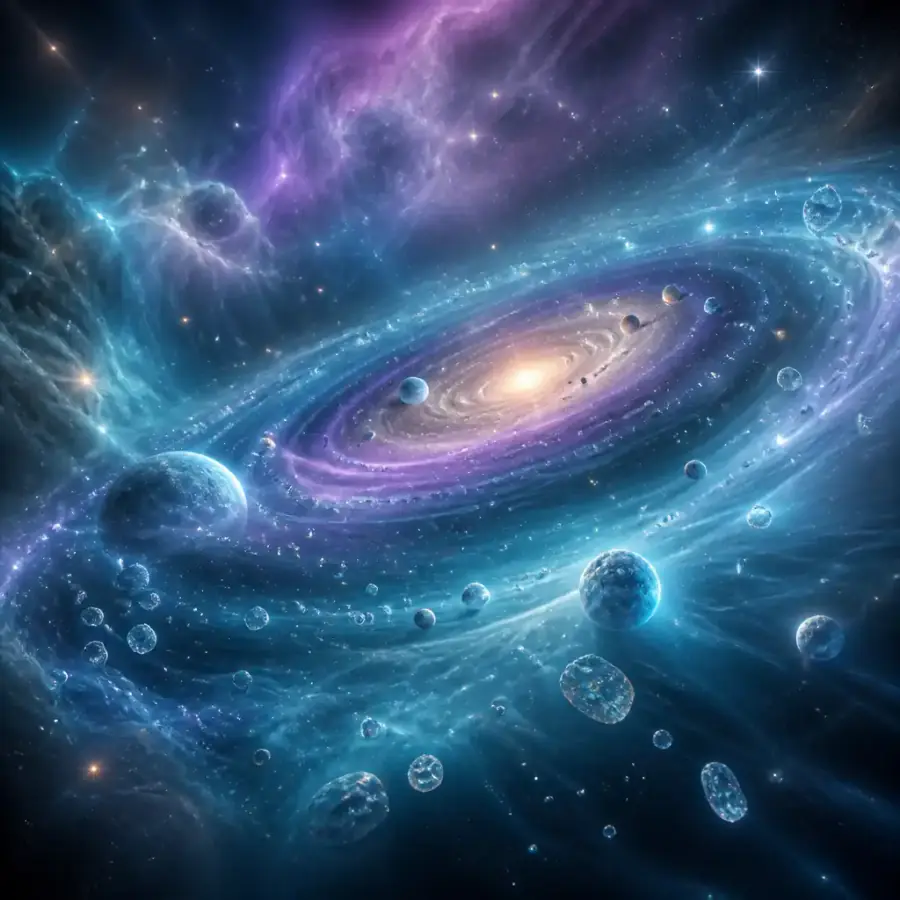
One of PRIMA's core objectives is to illuminate the obscured processes of planet and star formation, the evolution of galaxies, and the intriguing origins of water in the cosmos. These phenomena often occur within dense clouds of gas and dust that block visible and even near-infrared light. By observing in the far-infrared, PRIMA will cut through this cosmic veil, allowing us to witness these events as they unfold. Understanding how planets acquire water is particularly significant, offering insights into the potential for life beyond Earth. Multiple sources, including NASA's JPL, Caltech, and Mashable, emphasize that PRIMA will help us understand how planets obtain water and how black holes grow across billions of years of cosmic history.
The Invisible Architects of the Universe
Black holes, by their very nature, are invisible, neither emitting nor reflecting light directly. However, their profound influence on galactic evolution and star formation is undeniable. PRIMA is set to investigate how these cosmic behemoths grow and interact with their surroundings. The far-infrared spectrum is uniquely suited for this, as it can reveal the radiation from gas and dust heated by the activity around growing black holes, even if the black holes themselves are hidden behind thick clouds, as Turismo de Estrellas explains. This will allow us to study the feedback mechanisms between active black holes and their host galaxies, offering crucial data on how these titanic structures co-evolve across cosmic time. This is a critical step in understanding these enigmatic objects that NASA itself highlights are primarily detected and studied by their effects.
A Complementary Vision for Astrophysics
PRIMA is not designed to replace the James Webb Space Telescope but rather to complement its capabilities, extending our observational reach into a previously underexplored part of the electromagnetic spectrum. By doing so, it promises to complete our picture of the universe, from the coldest dust clouds where stars and planets are born, to the most obscured and actively growing supermassive black holes. This new window, expected in the 2030s, represents a significant step forward in astrophysics, promising to unveil cosmic secrets fundamental to our understanding of the universe's origins and evolution.
No topics yet: start the first one.
More stories
Why NASA's Moon Base Science isn't Just Research, It's Survival
The latest science investigations for NASA's lunar South Pole base are more than academic pursuits; they are critical blueprints for a safe, sustained human presence and a launchpad for deep-space exploration under the Artemis program.
NASA and IBM's Lunar AI: A Leap for Accessible Space Science
The open-source Lunar Foundation Model from NASA and IBM is poised to revolutionize lunar research, making decades of complex data available for unprecedented discoveries.
NASA's Pandora will sharpen the exoplanet hunt with a crucial focus
NASA's Pandora mission is preparing to delve into the atmospheric makeup of known exoplanets and their host stars, a nuanced approach that could fundamentally redefine our search for habitable worlds.
McGetchin Crater: The Moon's Dynamic Face Revealed Anew
NASA's Lunar Reconnaissance Orbiter has unveiled McGetchin Crater, a colossal 222-meter impact formed in 2024, challenging perceptions of a static Moon and offering unprecedented insights into cosmic collisions.