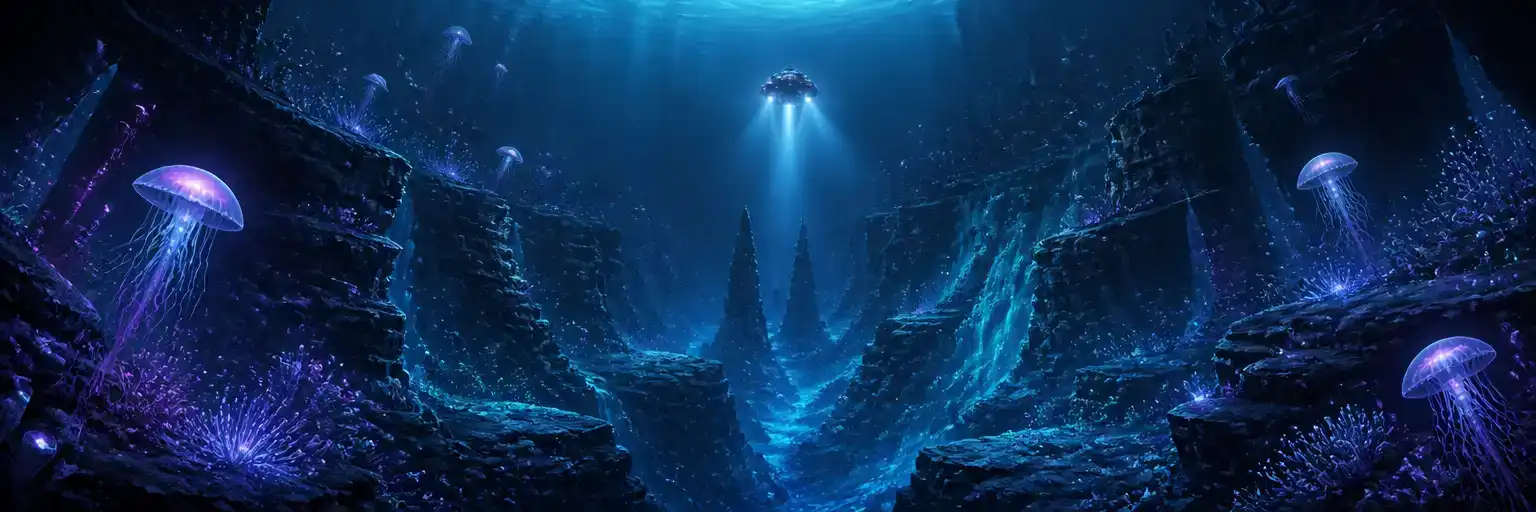
Ocean Crust Life: A Hidden World Rewriting Earth's Limits and Alien Prospects
The discovery of thriving ecosystems 2,500 meters deep within the Earth's oceanic crust fundamentally reshapes our understanding of life's boundaries and hints at extraterrestrial possibilities.
Photo: Centre for Geobiology/ University of Bergen , Norway. / Wikimedia Commons (CC BY-SA 3.0)
Could life exist where sunlight never penetrates, where temperatures are extreme, and pressures immense? For decades, our understanding of biological limits suggested a narrow window for such resilience. Yet, a recent scientific expedition has not only challenged these long-held assumptions but shattered them, revealing a hidden, thriving ecosystem deep within the Earth's oceanic crust. This finding does more than just fill in gaps in marine biology; it compels us to fundamentally rethink where life can take root, both on our own planet and, perhaps, across the cosmos.
The groundbreaking discovery, recently published in Nature Communications, unfolded on the East Pacific Rise. Scientists, led by marine biologists Monika Bright and Sabine Gollner, used a precise robotic vehicle named SuBastian from the Schmidt Oceanographic Institute to penetrate the seemingly impenetrable seafloor. At an astonishing 2,500 meters below the ocean surface, they uncovered warm, fluid-filled cavities within the crust itself. These subterranean havens were teeming with an unexpected community of organisms, including giant tubeworms of the species Riftia pachyptila, snails, and other mobile invertebrates, all adapted to perpetual darkness.
Life's Unyielding Tenacity Beneath the Waves
What makes this discovery so remarkable is not just the depth, but the environment itself. For a long time, the scientific community believed that deep-sea organisms thriving around hydrothermal vents—those volcanic chimney-like structures on the seafloor—were largely confined to their immediate vicinity. These creatures famously rely on chemosynthesis, a process where bacteria convert chemical compounds from the Earth's interior into energy, forming the base of a unique food chain entirely independent of sunlight. The new finding, however, indicates that life extends far beyond these localized vents, colonizing the very rock beneath them. We are talking about organisms living inside the planet's crust, a testament to life's profound adaptability.
The oceanic crust, often just 5 to 10 kilometers thick, is a dynamic and volatile environment, constantly being formed at mid-ocean ridges and recycled in subduction zones. That life could not only survive but establish complex communities within its internal structure, away from the direct outflow of vents, is a powerful statement about biological resilience. It suggests that the boundaries of what we considered
No topics yet: start the first one.
More stories
A Selfie and a Giant Water Lily: Social Media's Unexpected Role in Discovery
The tale of a critically endangered giant water lily discovered via Instagram underscores how public engagement and unconventional platforms are reshaping biological exploration and conservation.
Patagonian Yeast: A New Chapter in Evolution's Story
Recent findings from Chilean scientists in Patagonian wild yeast challenge conventional views on adaptation, suggesting evolution is more complex and dynamic than previously thought.
A Name That Echoes: New Amphibian Honors Brazil's Forgotten Conservationists
The scientific recognition of Siphonops maria not only celebrates a hidden amphibian but also shines a crucial light on the enslaved individuals who pioneered one of the world's greatest rewilding efforts.
Argentina's Deep-Sea Secrets Demand Urgent Ocean Protection
The discovery of 57 new deep-sea species in Argentina's Mar del Plata canyon dramatically underscores the urgent need for continued marine exploration and robust conservation efforts.