McGetchin Crater: The Moon's Dynamic Face Revealed Anew
NASA's Lunar Reconnaissance Orbiter has unveiled McGetchin Crater, a colossal 222-meter impact formed in 2024, challenging perceptions of a static Moon and offering unprecedented insights into cosmic collisions.
AI-generated image
For centuries, we have largely viewed our Moon as a static, geologically inert companion, scarred by ancient impacts but otherwise unchanging. Its pockmarked face seemed to tell a story of a past long gone, a cosmic punching bag with little to offer in terms of ongoing dynamism. However, recent findings from NASA's Lunar Reconnaissance Orbiter (LRO) challenge this perception, reminding us that even in the vast stillness of space, change is the only constant.
NASA recently announced the discovery of a colossal new lunar crater, named McGetchin, which formed as recently as 2024. This isn't just another dent in the Moon's surface; at a staggering 222 meters (728 feet) wide and 43 meters deep, it represents the largest newly formed crater identified so far in the solar system, as reported by La Razón and NASA Science. The impactor, believed to be a small asteroid or cometary fragment, struck the lunar surface sometime between April 11 and May 22, 2024, leaving an indelible mark, as detailed by NASA Science and Futura-Sciences.
A Once-in-a-Century Event, Caught on Camera
To put the size of McGetchin Crater into perspective, its width is roughly equivalent to two American football fields, according to NASA Science. While the Moon is peppered with countless craters, what makes McGetchin truly extraordinary is that we were able to observe its formation in almost real-time. This isn't a historical artifact to be studied through geological reconstruction; it is a fresh, quantifiable event. Many outlets have called it a "once-in-a-century" discovery, underscoring its rarity and scientific value, as noted by Record and NASA Science.
The Lunar Reconnaissance Orbiter (LRO) has the explicit objective of monitoring the Moon for changes, including newly formed impact craters, as highlighted by LROC. The LRO's continuous imaging has allowed scientists to compare before-and-after images of the impact site, providing a precise timeline of the event. This level of detail offers an unparalleled opportunity to study the mechanics of crater formation, the energy involved in such impacts, and the characteristics of the impacting object itself. For instance, the sheer volume of ejecta — the material thrown out from the impact — can be analyzed to understand the Moon's subsurface composition.
Unveiling a Dynamic Lunar Landscape
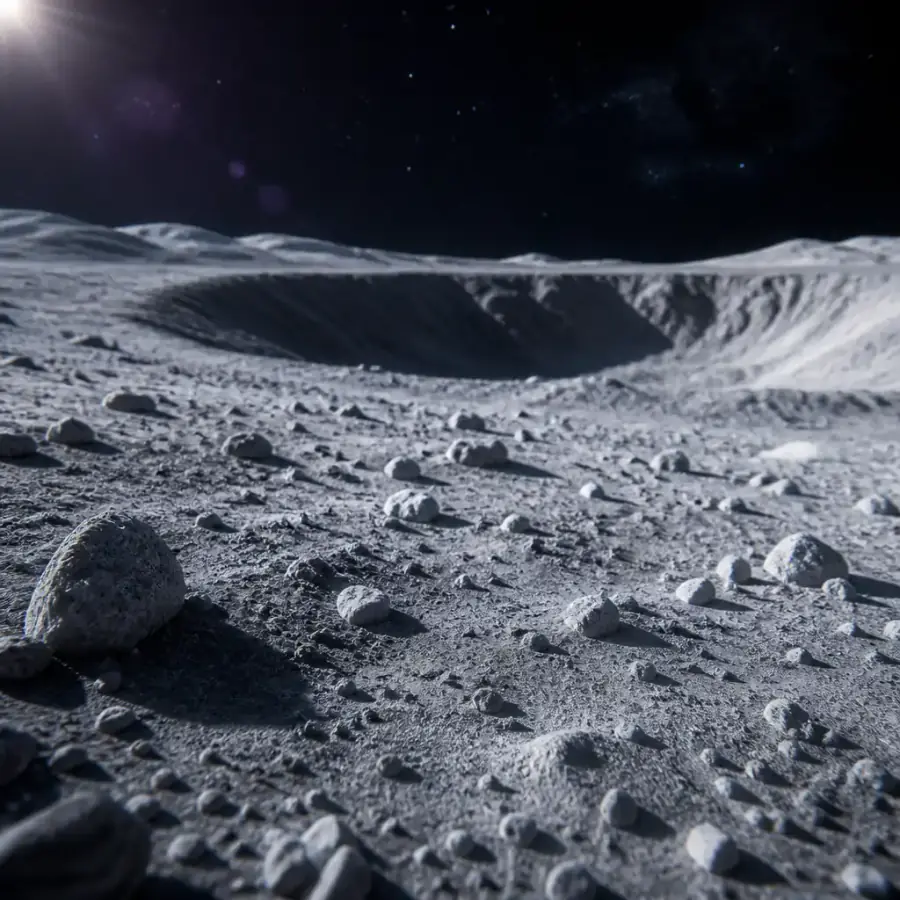
The discovery of McGetchin Crater significantly challenges the popular notion of the Moon as a geologically dead body. While it lacks plate tectonics and a molten core that drives Earth's dynamic surface, lunar impacts demonstrate an ongoing process of surface renewal. These events are not merely cosmetic; they play a crucial role in the continuous churning and mixing of the lunar regolith, the loose layer of dust and rock that covers the Moon's surface. This constant resurfacing can expose fresh material, influencing our understanding of the Moon's geological history and the distribution of valuable resources.
Furthermore, studying McGetchin Crater provides critical data for understanding impact frequencies across the solar system. By observing an impact of this magnitude within a relatively short observational window, scientists can refine models that predict how often objects of certain sizes strike planetary bodies. This information is vital not only for lunar science but also for assessing impact risks on other worlds and even for Earth itself. The ability to monitor, measure, and analyze such a fresh impact reinforces the LRO's role as a cornerstone of modern lunar exploration.
More Than Just Scars
In our view, McGetchin Crater serves as a powerful reminder that even seemingly barren celestial bodies are still active, evolving entities. The Moon is not merely a static relic of the past; it is a dynamic environment continually shaped by the cosmos. This discovery underscores the importance of ongoing planetary observation and deepens our appreciation for the subtle, yet profound, changes occurring in our solar neighborhood. Each new crater is a fresh page in the Moon's ongoing geological story, and we are fortunate to have the tools to read it.
No topics yet: start the first one.
More stories
Weather's Unyielding Grip: Why Spaceflight Still Bows to Earth's Whims
Despite advanced technology and reusable rockets, the Crew-12 mission's multiple launch delays and ongoing departure monitoring reveal how Earth's unpredictable weather remains a dominant force in space operations.
A Cosmic Ballet Unveiled: 12 Years of Exoplanet Orbits
A monumental 12-year time-lapse of a star and four orbiting exoplanets provides unprecedented insights into planetary dynamics and validates the power of long-term astrophysical observation.