James Webb's 'Empty' Signal: The Universe is Stranger Than We Thought
The James Webb Space Telescope has detected an intense, unexplained infrared signal from a region of space long considered barren, forcing a profound reevaluation of cosmic emptiness and the limits of our observation.
AI-generated image
What if the void we perceive in the cosmos is merely a veil, obscuring phenomena we are only just beginning to grasp? This provocative question is at the heart of the latest intriguing detection by the James Webb Space Telescope (JWST), an event that compels us to reconsider our very definition of 'empty' space.
Astronomers have announced the detection of a powerful, isolated infrared signal emanating from a tiny patch of the southern constellation Fornax. This region, famously known as the Hubble Ultra Deep Field, has been exhaustively cataloged for decades, with prior observations by both the Hubble Space Telescope and the JWST itself revealing no visible galaxies or stars at this specific location. Yet, the new data presents a bright emission line, observed not once, but twice, across two distinct observations 88 days apart in August and November 2023, consistently at different angles, making a mere glitch highly improbable, as reported by ScienceAlert.
This isn't just another faint cosmic echo; it's an intense signal that, had it been present, should have been clearly visible in the JWST's earlier JADES survey conducted in October 2022. Its sudden appearance, or rather, its detection now from a previously featureless void, has left researchers, led by astrophysicist Mason Huberty, searching for answers, probing the very edge of our current astrophysical understanding.
The Power of Infrared and Novel Techniques
The JWST's unique capabilities in the near-infrared and mid-infrared spectrum are precisely why such a discovery is even possible. Unlike optical telescopes, which are blinded by cosmic dust, JWST’s infrared vision allows it to pierce through obscuring clouds and detect light that has been significantly redshifted from the early universe, as detailed by NASA Ciencia. This is crucial for observing the earliest stars and galaxies or peering into star-forming regions. In this particular case, researchers employed a novel technique called Multiobject Coronagraphy for Slitless Spectroscopy (MOCSS) with JWST's Near-Infrared Spectrograph (NIRSpec). Instead of targeting known objects, they opened most of the instrument's shutters, closing only those covering identified foreground objects, effectively using the spectrograph to hunt for previously unseen emissions. This innovative approach transformed the spectrograph from a verification tool into a discovery engine, proving that sometimes, simply looking differently is enough to find the extraordinary.
Challenging Our Definition of 'Nothing'
The true enigma lies in the signal's isolation and its historical absence. It presents as a single, bright line at about 1.6 micrometers, unaccompanied by other emission lines that would typically characterize a known celestial body like a galaxy or a supernova. This solitary signature, without a visible source, confounds the usual methods of identification. The problem with a single line is its ambiguity; without additional spectral data or a known distance, it's difficult to determine if it's energetic light from a distant, highly redshifted source, or less energetic light from something closer. The universe's expansion stretches light, making distant objects appear redder and complicating identification, as explained by ScienceAlert. This observation underscores a critical point: our instruments, however powerful, can only detect what we are equipped and prepared to see, and the cosmos consistently finds ways to surprise us.
What Could It Be? The Unanswered Questions
While astronomers have put forward several hypotheses – an early universe galaxy, a more recent galaxy, or even a supernova – each comes with significant caveats. An early galaxy's light would struggle through the neutral hydrogen prevalent then, and both galaxy scenarios face the problem of not being present in the earlier JADES observations or lacking expected accompanying emission lines. A supernova would also typically produce a broader spectrum of emissions. This lack of a clean fit for any standard explanation suggests we may be witnessing a genuinely transient event of immense power, an entirely new class of cosmic phenomenon, or perhaps even an extreme version of something we thought we understood. It forces us to confront the possibility that the 'empty' patches of the sky are not devoid of activity, but rather host events or objects that defy our current models and observational strategies. The JWST, in its tireless exploration, continues to reveal that the universe is not just vast and ancient, but also profoundly mysterious and still full of surprises waiting to be unveiled by the right instruments and a dash of human ingenuity.
No topics yet: start the first one.
More stories
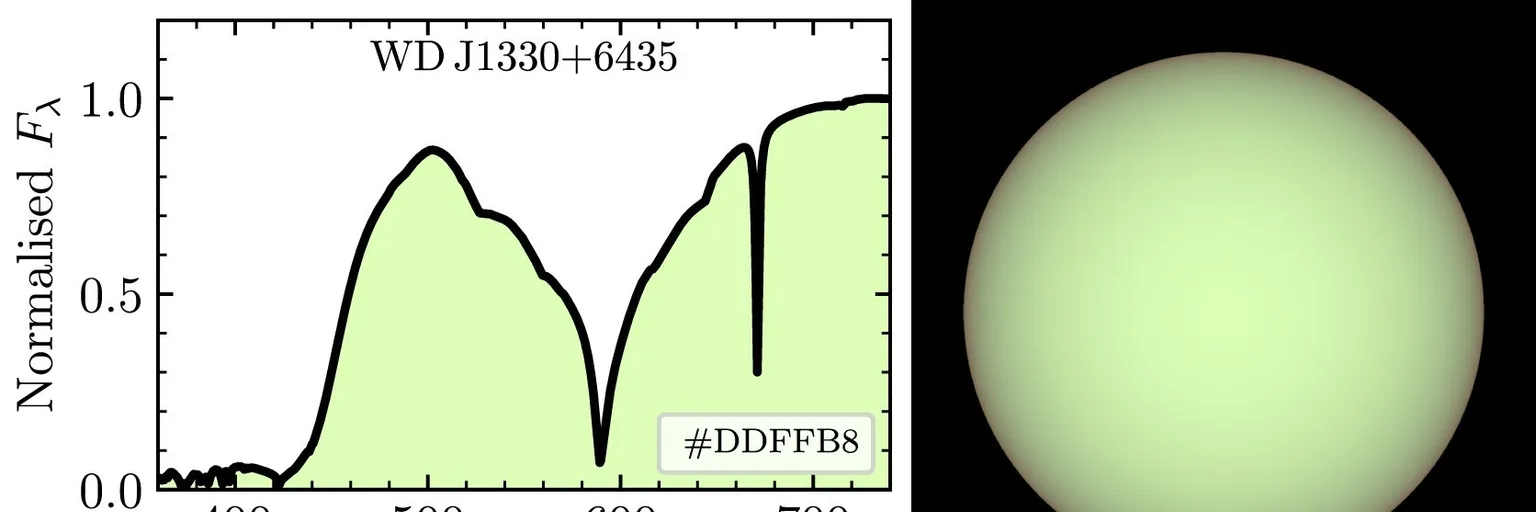
The First Green Star: Why Stellar Hues Are More Than Just Temperature
Astronomers have discovered the first star that would appear green to human eyes, challenging long-held assumptions about stellar colors and revealing a universe far more vibrant than we previously imagined.
Mars' Geometric Puzzles Hold the Key to Our Future on the Red Planet
Mysterious geometric patterns on the Martian surface are far more than aesthetic oddities; they are critical indicators of subsurface ice, offering a roadmap for human exploration and a deeper understanding of Mars' climatic evolution.
Artemis' Calculated Ascendancy: Why NASA's Patient Approach is Paying Off
After the Artemis II mission confirmed the Orion heat shield's robust performance and astronaut training intensified, NASA's deliberate, iterative strategy is clearly building a solid foundation for sustained lunar presence and deep-space exploration.

BioGravity-1: How Saudi Arabia's Space Mission Could Revolutionize Brain Research
The BioGravity-1 mission, launching the first biological samples from the Middle East into space, is a strategic move positioning Saudi Arabia at the forefront of understanding and treating neurodegenerative diseases.