Euclid's comet wasn't luck: it's what happens when you stare widely
A dark-energy telescope flagged a comet nobody had cataloged. The real lesson is that survey data should be mined for surprises on purpose, not by accident.
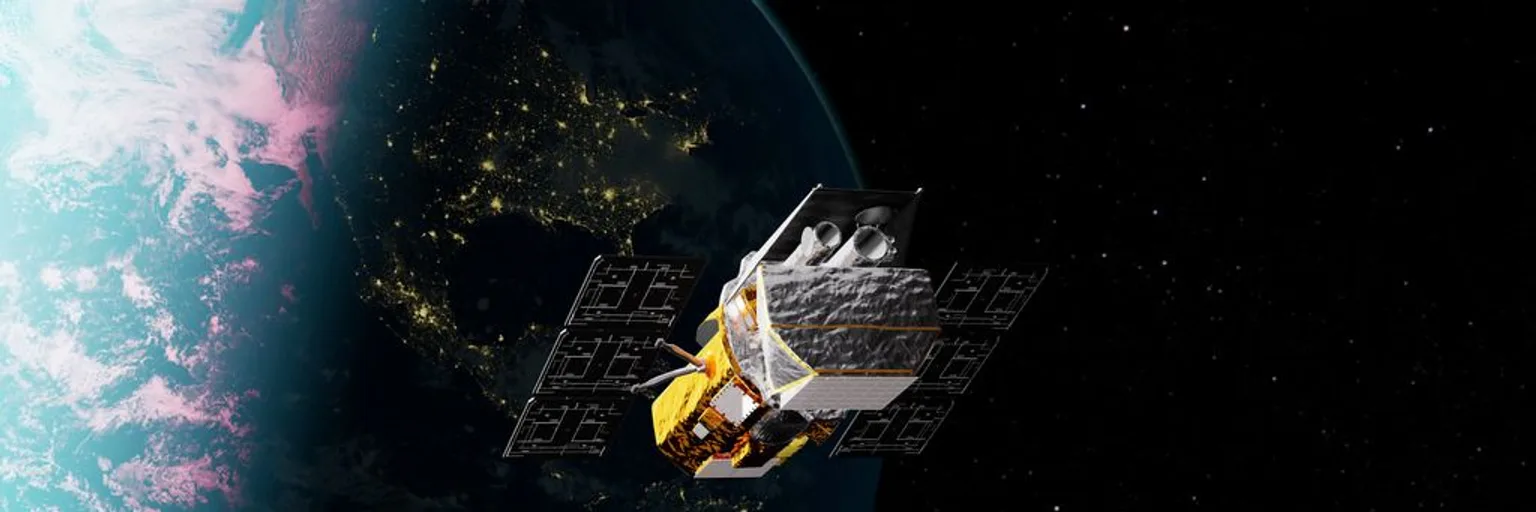
AI-generated image
Can you call a discovery an accident if you built the machinery to catch it? The European Space Agency's Euclid telescope was made to map billions of galaxies and probe dark matter and dark energy. It has just found a comet nobody had cataloged. The official word is "happy coincidence". We think the coincidence is the smaller half of the story.
What actually happened
According to ESA, Euclid captured the comet in images taken between September 16 and 24, 2026. Mikko Pöntinen, a PhD student at the University of Helsinki, had written software to monitor small Solar System objects in Euclid's data. It flagged a streak smeared across several images. He found the object in five image sets, 16 exposures in total, and saw a fuzzy cloud of dust and gas around it, the sign of an active comet.
Checks against known comets and asteroids turned up nothing. The Minor Planet Center confirmed a new comet on October 8, and it became C/2026 S1 (Euclid). The comet sits about 1.3 billion kilometers away, roughly between the orbits of Jupiter and Saturn. It is far above the plane of the planets, on an orbit that will take thousands of years to complete. Euclid had seen comets before, but this is the first new one it discovered.
The luck was in the geometry, not in the discovery
Euclid is close to the worst tool you could design for comet hunting. ESA says it deliberately avoids the comet- and asteroid-rich band along the Solar System's plane, to cut dust glare. Its step-and-stare strategy visits each patch of sky about once, so nobody can swing back for a second look. Bruno Altieri, the Euclid Archive Scientist, said very few comets are expected from Euclid. The orbit and the scanning happened to line up.
That is the real luck, and it is modest. The part that was not luck is everything after it. Software was already watching for moving objects, because Euclid has to scrub streaks out of its galaxy images anyway. A reporting channel to the Minor Planet Center existed. Ground-based observers could be alerted for follow-up. Remove any of those and the streak stays a smudge in an archive.
That matches what the Spanish outlet Merca2 argued: the valuable thing is the method, not the object. We agree, with one caveat. Plenty of surveys have fine data and no one looking for the off-topic. Serendipity in a big survey is closer to a tax you pay on enormous data volumes. You collect it only if you budget for it.
Plan for surprises, but don't oversell this one
The strongest argument for planning is Comet Interceptor, the future ESA mission built with JAXA. It is meant to wait in space and then target a pristine comet or, if one turns up, an interstellar object. That only works if candidates are spotted early, while still far from the Sun. ESA says the quick turnaround between identification and validation shows Euclid can detect new comets at that stage. This particular comet is not a suitable target, Altieri said. But Valeria Pettorino, the Euclid Project Scientist, called it a real test case for how the two mission teams will coordinate.
Now the brakes. This is one well-documented detection, not a systematic survey. The orbit still needs refining. The comet has no spectacular tail and isn't approaching the Sun. Anyone reading "strange comet heading toward Earth" into the headlines is reading the wrong story. Nothing in the documentation suggests a threat, and a body 1.3 billion kilometers away is not one.
Our verdict: the lesson isn't "Euclid got lucky". Agencies should treat the side channels of flagship surveys as a standing, funded science product. That means moving-object pipelines, alert protocols and trained people, written into mission plans from day one. Euclid's dark-energy map remains the headline goal, and nothing here changes that. But the cheap extras are where a mission quietly pays for itself. Pöntinen's streak is a reminder that the next one will only be caught if someone is already watching for it.
No topics yet: start the first one.
More stories
The first exomoon deserves applause, and a long wait before we believe it
A giant companion around a brown dwarf is a genuine milestone for method. But exomoon claims have burned us before, and "plausible" is not "confirmed."
Pluto's landslides don't prove it's alive, but they bury the "dead ice ball" idea
Six huge collapses in New Horizons images show Pluto's surface has been reshaped in ways we hadn't confirmed. That's progress, but it's not proof of present-day activity.
The Sun's death may be far rougher on Jupiter and Neptune than we assumed
A new simulation study says the Sun's lumpy mass loss could scramble the giant planets within billions of years. Treat it as a scenario, not a prophecy, but a useful one.

Swift isn't dying of neglect: nobody ever built it to be fixed
NASA did try to reboost Swift, and the attempt failed. The real lesson isn't about skipped maintenance but about telescopes designed without a repair option.