Mars' Cleaner Ice Rewrites Its Violent Climate Story
A re-evaluation by the University of Washington has drastically cut the estimated dust in Mars' northern polar ice cap to about 3%, fundamentally altering our view of the planet's past climate and water history.
AI-generated image
What if much of what we thought we knew about a planet's climate history, stretching back millennia, was based on a flawed assumption? That's the provocative question raised by recent research from the University of Washington, which has significantly revised the estimated dust content in Mars' northern polar ice cap. This isn't merely a minor statistical adjustment; it's a re-calibration that forces us to rethink the Red Planet's hydrological cycle, its dramatic climatic shifts, and even the tantalizing prospect of ancient life.
For years, scientists grappled with widely varying estimates of dust in Martian ice, with figures for the top layer ranging up to 25% by mass. This discrepancy, it turns out, stemmed from an analytical method originally developed for lunar soil that proved inaccurate when applied to Earth ice, casting doubt on its Martian applications. Now, a team led by University of Washington research scientist Aditya Khuller and geosciences graduate Pari Mohan has presented a new, more robust estimate: the exposed north-polar water ice contains roughly 3% dust by mass, a finding published in npj Space Exploration on September 8, 2026 as reported by SciTechDaily. This marked reduction, from potentially one-quarter dust to merely 3%, promises to reshape our understanding of Mars.
A New Lens on Martian Climate Dynamics
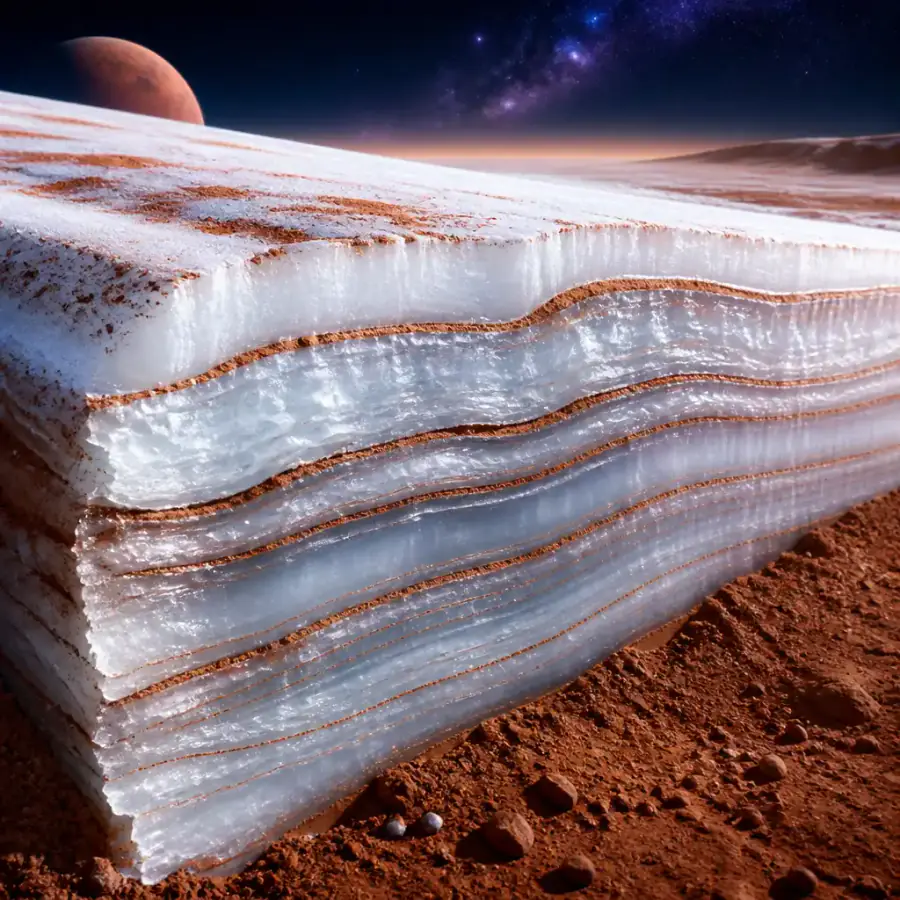
The proportion of dust within planetary ice is far more than a geological curiosity; it's a critical variable in understanding climate. As Khuller explains, a darker, dustier ice surface absorbs more sunlight, heats up faster, and vaporizes more quickly on Mars, much like a dark T-shirt warms more in the sun according to Infobae. Therefore, if Mars' northern polar ice is significantly cleaner, it suggests a more stable, less rapidly sublimating ice sheet than previously modeled. This implies that these vast frozen reservoirs could have persisted longer and preserved more detailed records of the planet's past atmospheric conditions and water cycles. It offers a clearer window into how Mars has responded to its
No topics yet: start the first one.
More stories
Why NASA's Moon Base Science isn't Just Research, It's Survival
The latest science investigations for NASA's lunar South Pole base are more than academic pursuits; they are critical blueprints for a safe, sustained human presence and a launchpad for deep-space exploration under the Artemis program.
Beyond Webb: Why NASA's Prima telescope promises unseen cosmic revelations
NASA's new far-infrared space telescope, Prima, is a critical leap in astrophysics, set to unlock mysteries about planetary water acquisition and black hole growth beyond even the James Webb's perception.
NASA and IBM's Lunar AI: A Leap for Accessible Space Science
The open-source Lunar Foundation Model from NASA and IBM is poised to revolutionize lunar research, making decades of complex data available for unprecedented discoveries.
NASA's Pandora will sharpen the exoplanet hunt with a crucial focus
NASA's Pandora mission is preparing to delve into the atmospheric makeup of known exoplanets and their host stars, a nuanced approach that could fundamentally redefine our search for habitable worlds.