Bikar and Bokak show why a pristine reef is a yardstick, not a postcard
Two remote Marshall Islands atolls give scientists a rare picture of an intact reef, and that makes protecting reference sites as urgent as restoring damaged ones.
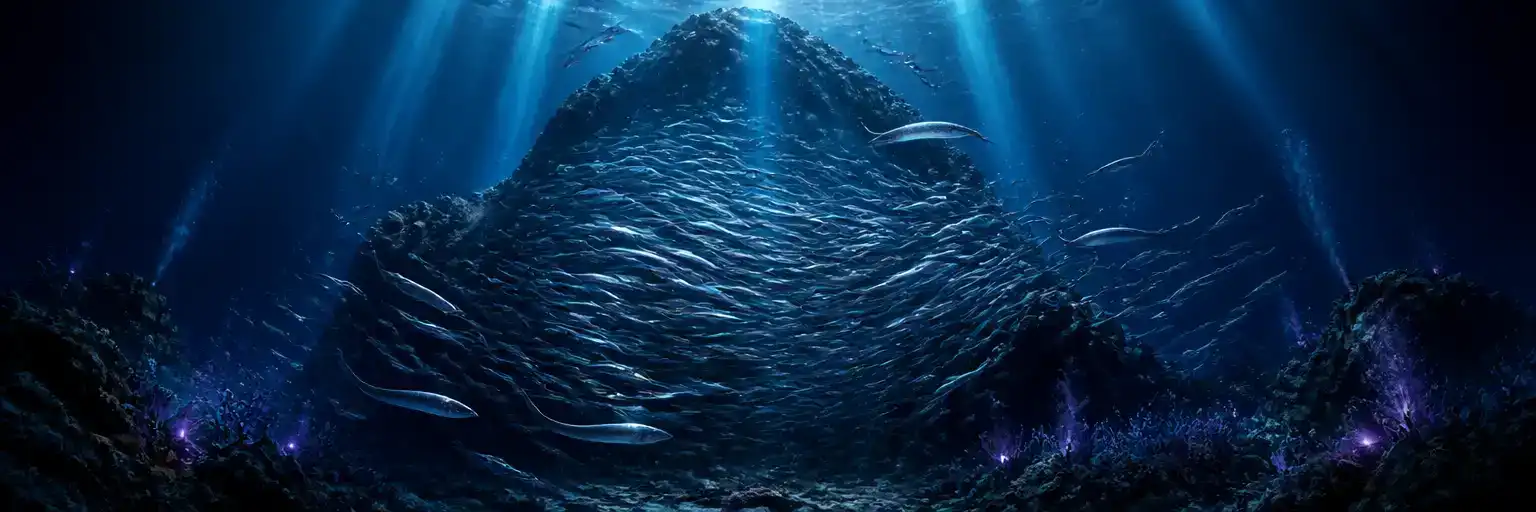
AI-generated image
How do you know a reef is healthy if you have never seen a truly healthy one? Most of us, scientists included, judge reefs against other reefs that people have already fished, polluted and warmed. That is a ruler with the end sawn off. A new survey of two atolls in the Pacific is a reminder of why we need an intact one to measure against.
The atolls are Bikar and Bokak, the northernmost in the Marshall Islands. According to a study summary cited by Xinhua, they lie about 116 and 385 kilometers from the nearest inhabited atoll. A team led by marine ecologist Alan Friedlander of the University of Hawaii surveyed them with underwater cameras, dives and even a submarine, and published the work in Frontiers in Marine Science. As Der Spiegel reports, the researchers describe them as probably among the most intact ecosystems in the region and possibly in the world. The surrounding area, roughly 48,000 square kilometers, is now the country's first national marine sanctuary.
The headline is the wildlife; the real story is the ruler
The numbers are striking: 15 seabird colonies with suspected or confirmed breeding, 266 groups of reef fish, more than 200 groups of deeper-water and deep-sea fish, and 15 groups of predators such as sharks and mackerel. Fourteen of the observed groups had not been recorded in the Marshall Islands before, and two could be entirely unknown species. Those are the details that make headlines, and they are impressive.
But in our view the most important sentence in the coverage is not about a species. It is Friedlander's point that few places on Earth, from the deep sea to the highest peaks, have escaped human traces. The scientific value of Bikar and Bokak is that they show how an ecosystem works with minimal human influence. The paper itself, in its own words, frames them as "ecological reference systems and important conservation baselines for evaluating future ecological change" in Frontiers. A baseline is not a trophy. It is a tool.
Without a baseline, we mistake decline for normal
Here is the uncomfortable consequence. When a restoration project asks what a reef should look like, it usually answers with the best degraded example nearby. Targets creep downward, and each generation of managers considers the reef it inherited to be natural. Only a site that has barely been touched can break that loop, because it lets you ask concrete questions: how many predators, how much of the fish community, what seabird presence does a healthy atoll sustain?
That is why we think the usual framing, restoration versus protection, is a false choice. Restoration without reference sites is aiming in the dark. Protecting reference sites without ever applying what they teach is a museum. The two only work together, and the reference sites are the scarcer half. You can replant degraded reefs; you cannot manufacture a new untouched one.
There is a pointed contrast in the region. National Geographic notes that Bikar and Bokak stand against Bikini Atoll, a nuclear test site after World War II, where Pristine Seas set up long-term monitoring sites and used Rongerik Atoll as an unbombed reference. Comparison sites are exactly how that kind of work gets done.
Caveats the excitement should not drown out
Three limits are worth stating. First, "intact" here is a researchers' assessment, and the coverage hedges with "perhaps" and "possibly" the world's most intact; we would not treat the superlative as settled. Second, the news coverage we have lists counts of "groups," not detailed measurements such as coral cover or fish biomass, so the finer comparisons with other reefs remain to be read in the full paper. Third, distance protects against fishing and coastal pollution, not against everything. We would not assume remote means immune to a warming ocean, and the sources we reviewed do not say otherwise.
That last point is our opinion, not a finding, but it shapes the recommendation.
Verdict: monitor the baseline before you need it
The sanctuary declaration is the right first step, and the Marshall Islands deserve credit for it. The next step is less glamorous: repeated, standardized surveys, so that Bikar and Bokak function as a time series and not a single snapshot. A baseline you visit once is an anecdote. Funders and governments tend to reward rescue stories over upkeep of a yardstick, and we think that is backwards. Protect the reference sites first, measure them regularly, and then judge every damaged reef against them.
No topics yet: start the first one.
More stories
Two new howler monkeys prove we haven't finished counting
Two new howler monkey species in the Amazon, found through genetic analysis, show how much life we undercount, and why naming a species is a duty rather than a trophy.

The "dinosaur-era" giant fungus isn't a fossil, and that matters
A 2.2-kilo fungus from Yunnan is being sold as a relic of the dinosaur age. The coverage says something different, and the gap is the real story.

Spider silk's 'secret' is out, but a lab fiber isn't a factory
Researchers say they've seen how black widows turn liquid into a fiber stronger than Kevlar. It's promising science, but scale-up evidence, not headlines, will decide whether it matters.
2.8 million eels on one seamount: the deep is still a blank map
A single undersea peak off Tasmania hosts a swarm of millions of deep-sea eels nobody had counted. It's a warning to map the deep before anyone thinks about exploiting it.