Bennu's grains prove sample return is rewriting Solar System history
Stardust, outer-Solar-System ice and room-temperature water in 120 grams of rock: Bennu shows that bringing dirt home beats any flight milestone at changing what we know.
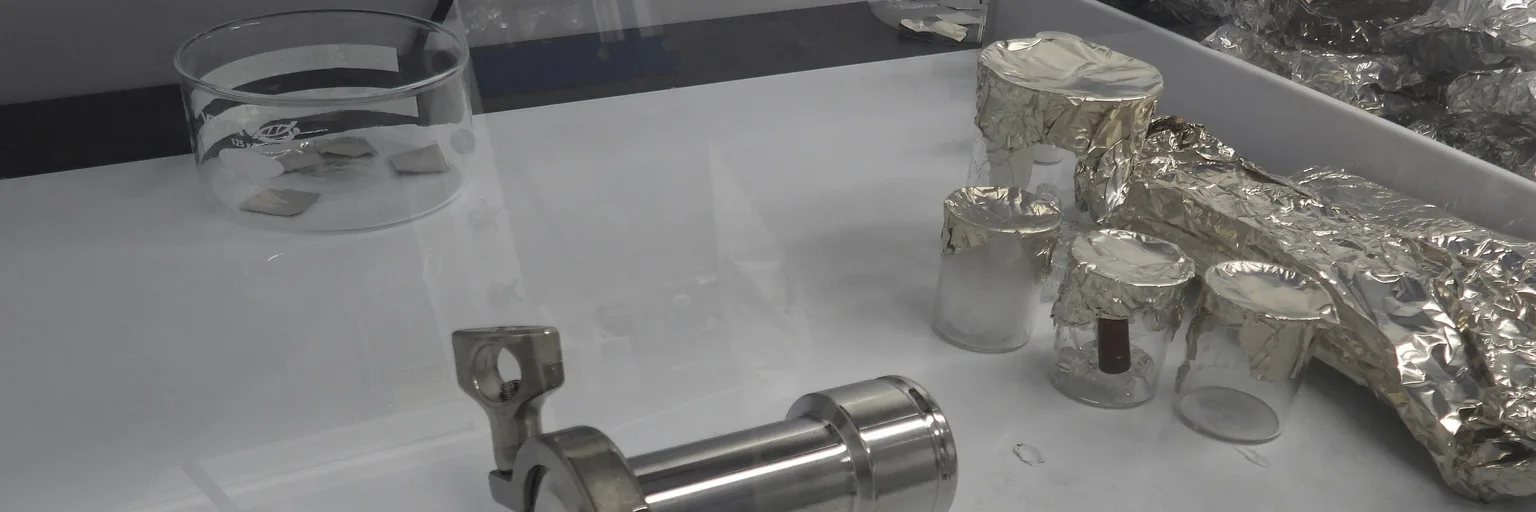
Photo: NASA Goddard Space Flight Center / Molly Wasser / Wikimedia Commons (Public domain)
Which is the bigger achievement: landing a spacecraft on an asteroid, or what a few grains from it tell us years later? We would argue, without much hesitation, for the grains. Bennu is the best current exhibit.
What the samples say
OSIRIS-REx dropped a capsule with about 120 grams of Bennu material in 2023. As the University of Arizona explains, three papers published in August 2025 found that Bennu is made of fragments of a larger parent asteroid. That parent was built from material with diverse origins: near the Sun, far from the Sun, and from other stars. Researcher Jessica Barnes said the parent "may have formed in the outer parts of the solar system, possibly beyond the giant planets, Jupiter and Saturn."
The same work reports that icy material accreted by the parent melted over time. The resulting water reacted with silicate minerals at about 25 degrees Celsius, and 80% of the minerals in the samples contain water. In September 2026, Phys.org reported that the samples point to a surprising origin. We have only seen the summary of that piece, so we won't lean on its details here.
The mixing bowl is the real headline
The detail we find most interesting is easy to miss. Bennu resembles Ryugu and the most primitive meteorites, which suggests their parents formed in a shared region. Yet the differences in the Bennu samples, per the same release, may indicate that the starting materials there "changed over time or were not as well-mixed as some scientists have thought."
That is a limit worth stating, and also an invitation. In our view, the early Solar System was not a tidy set of orbital lanes where each rock stayed where it was born. Stardust, interstellar organics and solids that formed closer to the Sun all ended up in one body. Material from the cold outskirts apparently took part in building something we can now hold in a lab. This is a claim about mobility and mixing, and it comes from isotopes measured at nanometer scales, not from any telescope. "This is work you just can't do with telescopes," Barnes said, and we couldn't put it better.
A caveat: "formed far away" is a hypothesis built on interpretation. Barnes herself says "may" and "possibly." Those are measured words, and the field will probably argue about them for years. That is how healthy science looks, and it is exactly why the physical samples matter: the argument can be settled with more measurements, not more speculation.
Why returning samples beats the flight milestones
Touch-and-go sampling was a feat. But the 2023 first look, as Naukas described it, was only preliminary, and NASA planned to keep 70% of the samples for future techniques, ones that, in Naukas' words, will perhaps be used by researchers who haven't been born yet. That is the point. A flyby delivers a snapshot. A sample delivers an archive that every new instrument can reinterrogate.
The follow-ups seem to confirm it. In December 2025, papers reported sugars including ribose and glucose, plus a gum-like material never seen before in astromaterials. NASA's account is clear that the sugars are not evidence of life, and we agree: this is chemistry, not biology. But it shows how much one small container can keep producing, years after the capsule landed.
Who loses? Anyone who treats sample return as expensive souvenir collecting. Who wins? Models of the early Solar System, which now have hard isotopic constraints instead of spectra from afar. We would also add the public: a few grams of rock is a far easier story to grasp than a trajectory plot.
Our verdict
If you want to follow where planetary science is really moving, watch the lab papers, not the launch videos. Bennu's lesson is that the Solar System's past was probably messier and better traveled than the tidy versions suggested. The next test is whether other returned samples show the same imperfect mixing. If they do, textbook diagrams will need redrawing.
No topics yet: start the first one.
More stories
Psyche's slow blue burn is the real story, not a metal jackpot
NASA's Psyche is thrusting almost nonstop toward a metal-rich asteroid. The quiet triumph is solar-electric propulsion, and the prize is understanding how planetary cores form.
DART was the stunt; Hera is the science that makes it a defense
Crashing a spacecraft into an asteroid grabbed headlines in 2022. Hera, arriving at Didymos in early November, is what could turn that one-off shot into a method we can trust.
LHS 1140 b is a promising ocean world, not Earth's twin
Headlines promise an "Earth-like" planet 49 light-years away. The data show something stranger and more interesting: a strong water-world candidate whose atmosphere is still unconfirmed.
OSIRIS-REx's real legacy is the sample, not the flight
The strongest argument for sample return is already in the labs: Bennu's grains keep answering questions no telescope or probe could, and the funding should follow.