Webb's cloudy super-Jupiter shows we're finally imaging worlds like ours
Epsilon Indi Ab, 12 light-years away, isn't Jupiter's twin. But a cold giant with probable water-ice clouds shows direct imaging has crossed a line, and the models now have homework.
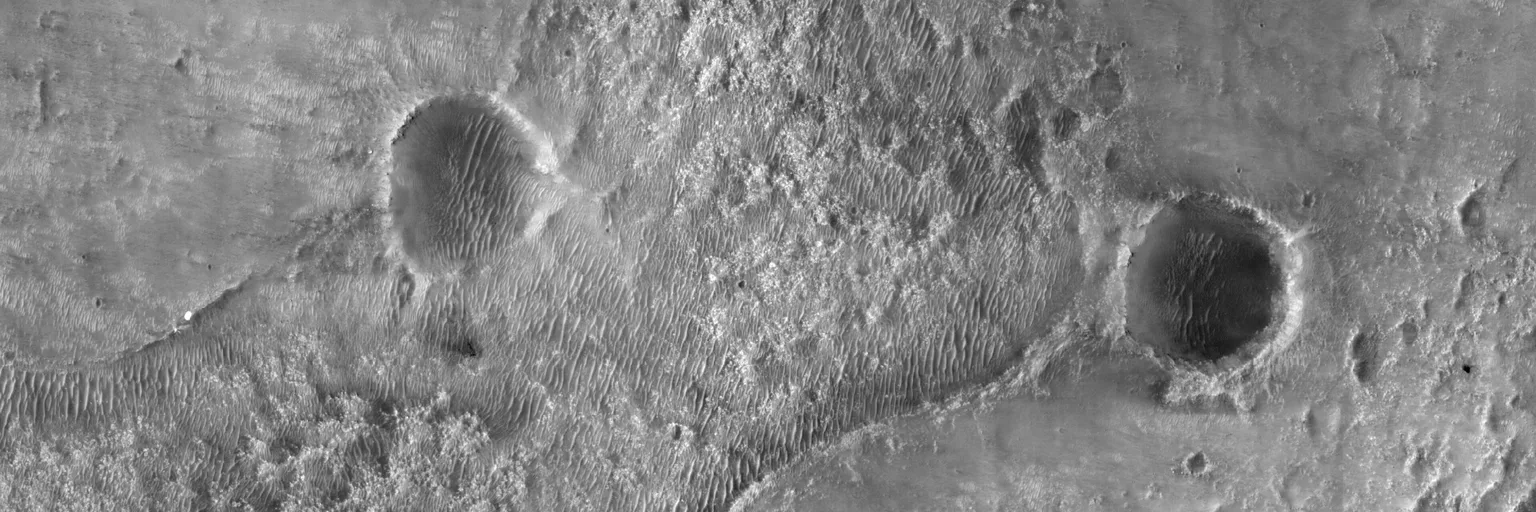
AI-generated image
For two decades, the exoplanet pictures we imagined were mostly of scorched giants hugging their stars. Now Webb has delivered something closer to home: a cold giant, 12 light-years away, that appears to be wearing cirrus-like clouds of water ice. Is this the moment direct imaging finally reaches true Jupiter-like worlds? Almost. And the "almost" is the interesting part.
Webb saw a best-fit explanation, not proof of clouds
The planet is Epsilon Indi Ab. Per EarthSky, a team led by Elisabeth Matthews at the Max Planck Institute for Astronomy reported on April 22, 2026, in the peer-reviewed Astrophysical Journal Letters, that it orbits at about Neptune's distance and weighs roughly 7.6 Jupiter masses. Webb's MIRI coronagraph blocked the star's glare. Comparing images at 10.6 and 11.3 microns, the team found ammonia, but less than expected. Patchy water-ice clouds are the best explanation.
Note the wording: best explanation, not proof. Earth.com's summary is clear that metal-poor or nitrogen-poor chemistry could also flatten the ammonia signal, though each option creates trouble elsewhere in the spectrum. This is photometry in two narrow windows, not a full spectrum.
The real milestone is the target, not the clouds
The headline is the clouds. We think the story is the planet. Matthews said Webb is "finally allowing us to study solar-system analogue planets in detail." Most directly imaged planets so far have been young, hot and bright. Epsilon Indi Ab sits around 200 to 300 kelvin, with Jupiter near 140 K. Its leftover formation heat makes it warmer, but it is by far the closest thing to a Jupiter that imaging has given us.
Transits can't do this job. Cold giants rarely line up in front of their stars, so the method favors hot, close-in planets. Direct imaging is one of the few ways in. That is a quiet but real shift: the census of exoplanets has been biased toward worlds unlike our own, and this is the first crack in that bias.
Let's keep it in proportion, though. A "bright dot" is what Webb gives us. It is not a portrait. And, per BBC Sky at Night Magazine, the planet that turned up was about twice as massive as the radial-velocity hints had predicted, a little farther from its star and on a different orbit. Calling it a Jupiter twin oversells it. "Nearest cold giant we can study" is the honest label.
The bigger lesson is about models, not telescopes
The most useful finding may be an embarrassing one. Many atmosphere models leave clouds out because they complicate the calculation. If you don't model clouds, you may not notice them, or you may misread their effects as strange chemistry. Co-author James Mang called it "a great problem to have," and we agree. Better data is exposing the shortcuts.
This should change how searches near the Sun are planned. First, target selection: radial-velocity and astrometric hints, like those that pointed to this system, are the way to find cold giants worth imaging. Second, interpretation: cloud physics has to be built in before we trust any inferred composition. Third, sample size. One planet can't say whether missing ammonia is normal or a fluke, so the team wants more cold giants.
Some claims around this result stretch further than the evidence. Earth.com frames it as a step toward finding Earth-like worlds. Matthews herself says studying Earth in comparable detail would need telescopes that don't exist yet. We would treat the Earth angle as a long-term rehearsal rather than a near-term payoff. Still, the Nancy Grace Roman Space Telescope, which carries its own coronagraph and, per EarthSky, can also observe this planet, gives a chance to cross-check Webb's heat measurements with reflected light.
Our verdict
Don't read this as "Webb found weather on another Jupiter." Read it as proof that the nearby cold-giant population is now reachable, and that our tools for interpreting it are behind. The sensible response is more targets, more wavelengths and cloud-aware models, in that order. Until a full spectrum arrives, hold the ice clouds as a strong hypothesis. The planning lesson, though, doesn't depend on whether they survive.
No topics yet: start the first one.
More stories
Saving Hubble is the easy part; deciding what for is not
NASA's request for ideas to boost, service or retire Hubble is cheap and sensible, but it exposes a harder question: how much to pay to keep an old telescope alive.
Hubble deserves a rescue attempt, but only if NASA is honest about the risk
NASA is asking industry whether Hubble can be boosted, serviced or brought down in a controlled reentry, and the answer will show if we maintain great observatories or just use them up.
Voyager 1's two-day silence is a warning, not a eulogy
A decades-old probe went unheard in two scheduled contacts and then came back on its own. The real lesson is about the Earth-side antennas and engineers who keep listening.
Martian dust is a lung problem, and we should fund toxicology now
Perseverance measured dust grains of about 100 nanometers over 1,645 sols. Protecting astronauts' lungs is a design problem as serious as the rocket, and it needs money today.