Venice's Hidden Freshwater: A Treasure Best Left Untouched
A vast subterranean freshwater reservoir near Venice holds immense potential for a drought-stricken region, but its strategic importance lies in protection and precise management, not exploitation.
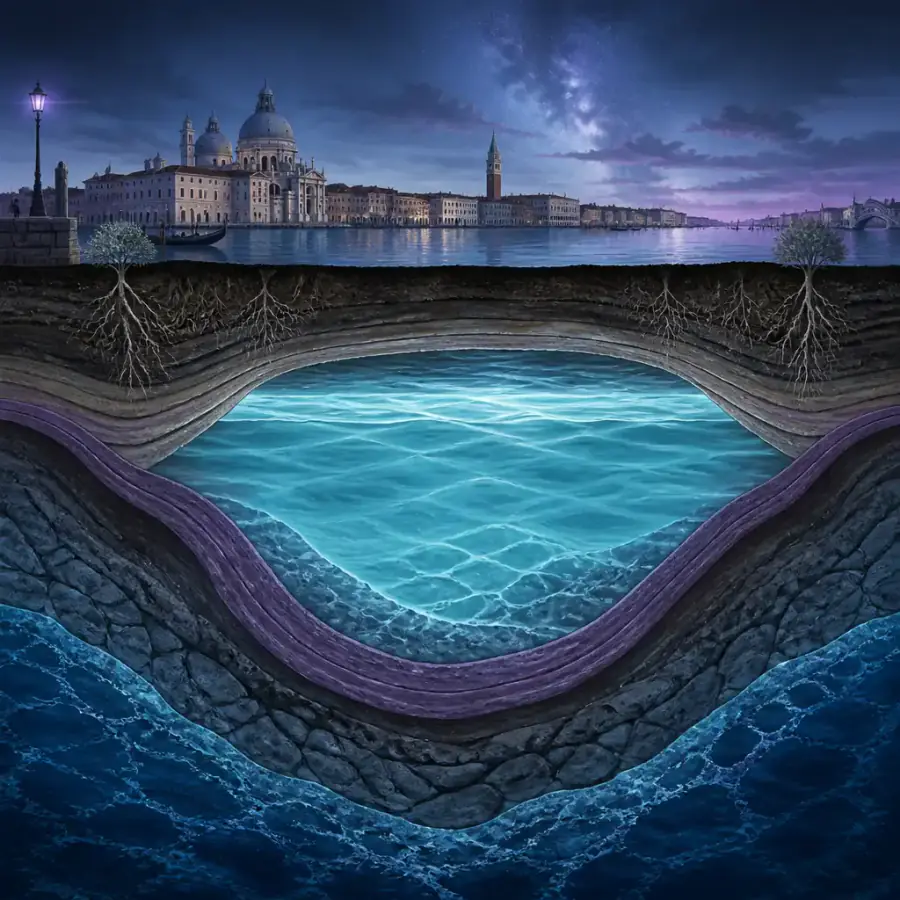
AI-generated image
Could an underground lake, comparable in size to Italy's iconic Lake Garda, be the answer to Venice's historic struggle with freshwater and the looming threat of climate change? Researchers have indeed unearthed a colossal freshwater reservoir beneath the coast near Venice, a discovery that has understandably generated significant excitement. However, a deeper look reveals that this isn't a simple tap to open, but a complex hydrological system demanding a rigorous, cautious approach to its management.
First detected in May 2025, but making headlines now, this immense freshwater body lies at a depth of about 30 meters between Cavarzere and Chioggia, two municipalities in the Province of Venice. Spanning nearly 30,000 hectares (300 square kilometers), its area is comparable to Lake Garda, which measures 368 square kilometers, though it is approximately 70 square kilometers smaller, as noted by Il Dolomiti. This isn't an open cavern filled with water, but rather an "acquitard": a deep layer of permeable sediments holding freshwater, protected by thick, less permeable clay and silt layers, which serves as a natural barrier to saltwater intrusion.
Venice's Enduring Freshwater Paradox
For centuries, Venice has grappled with the paradox of being a city surrounded by water, yet historically short on fresh drinking water, as highlighted by the Water Museum of Venice. The discovery of such a vast freshwater reserve beneath its coastal areas, especially in a region frequently afflicted by drought and the encroaching "cuneo salino" (salt wedge intrusion), feels like a lifeline. Lorenzo Frison, an engineer with the Adige Euganeo Reclamation Consortium and head of the SWAMrisk project, explained to VeneziaToday that the deep giacimento is "little subject to saltwater intrusion and is affected only extremely slowly by marine ingressions." This contrasts sharply with superficial aquifers, where salt concentrations can reach 14 grams per liter at around seven meters deep, severely damaging agricultural crops.
Local authorities, like the mayor of Chioggia, Mauro Armelao, have expressed enthusiasm, viewing the discovery as a potential "strategic resource, especially for agriculture." However, the scientific community emphasizes a nuanced perspective. While the existence of this reserve is invaluable, its potential for direct exploitation is severely limited.
The Peril of Pumping: Why Extraction is Not an Option
Despite its appealing size, this subterranean freshwater body is not a readily accessible resource. As Il Nordest reports, direct, systemic exploitation for agricultural or domestic use is largely unfeasible. Luigi Tosi, a research director at the CNR and a key figure in the field research, issued a clear warning against intensive water extraction, which he termed the "Atlantis effect." Such actions could lead to increased saltwater intrusion into lower layers or, worse, trigger unpredictable subsidence phenomena in an already geologically fragile area, where land can be up to four meters below sea level.
Tosi asserts that the basin "must be absolutely protected, excluding the use of extraction wells and massive extractions." Limited recourse, he suggests, might be conceivable only in "emergency cases, dictated by extraordinary drought, preceded by careful evaluations and respectful of the natural asset." This careful stance underscores the paradox: a vital resource exists, but its very presence depends on its undisturbed state. The true value lies not in pumping it, but in understanding and preserving it.
Mapping the Future: Hydrocloud and Collaborative Science
The discovery itself emerged from the European SWAMrisk project (Subsurface Water monitoring and Management to prevent drought risk in coastal systems), an Interreg Italia-Croazia initiative funded by the EU. This project focuses on understanding and mitigating the vulnerability of coastal aquifers to climate change. Its core objective, as CNR's Luigi Tosi explained, is to acquire new hydrogeological data to develop models that identify the most effective mitigation interventions.
Central to this effort is Hydrocloud, an innovative, open-access predictive tool that collects and systematizes a vast amount of hydrogeological data, including salinity, electrical conductivity, water temperature, and groundwater levels. Presented in Venice within the framework of SWAMrisk, this platform aims to transform water risk management and coastal soil preservation. Francesco Vincenzi, president of ANBI (National Association of Reclamation Consortia), highlighted that Hydrocloud's risk maps will be crucial for guiding public works and infrastructure projects, such as the proposed Brenta river barrier and new freshwater reservoirs, essential for water security and resilience.
In our view, the subterranean freshwater reserve near Venice represents not a miracle solution for immediate water needs, but a profound scientific revelation. It is a powerful reminder of the hidden complexities of our planet's hydrological systems and the urgent need for meticulous research and international cooperation. The real treasure here is the knowledge gained through projects like SWAMrisk and tools like Hydrocloud, which equip us to protect our finite resources, rather than rushing to exploit them, thereby safeguarding the delicate balance that sustains these vulnerable coastal ecosystems.
No topics yet: start the first one.
More stories
The Ice Walls Are Falling: A Climate Crisis Beyond Sea Level Rise
The rapid melting of polar ice caps and glaciers is not just raising sea levels; it's unleashing a cascade of environmental feedback loops that accelerate global warming and reshape our planet's future.