The Great Pyramid's Hidden Depths: A New Era for Archaeology
Modern physics, through techniques like muography and ground-penetrating radar, has transformed our understanding of the Great Pyramid and the Giza plateau, revealing secrets untouched for millennia.
AI-generated image
For centuries, the Great Pyramid of Giza has stood as an inscrutable marvel, its inner workings a source of endless speculation and a testament to the ingenuity of an ancient civilization. Yet, for all its visible grandeur, we are only now truly beginning to understand its hidden complexities, thanks not to picks and shovels, but to cosmic rays and advanced physics. The revelation of massive, previously unknown internal spaces and external anomalies has done more than just add new chambers to a 4,500-year-old structure; it has redefined the very tools and approaches of ancient Egyptian archaeology.
The most significant internal discovery, spearheaded by the ScanPyramids project and announced in November 2017, involved peering into the pyramid’s core without disturbing a single stone. By tracking muons – subatomic particles that constantly shower Earth from space – scientists were able to create a kind of X-ray of the colossal monument. This revealed a significant internal space, at least 30 meters long, located directly above the pyramid’s Grand Gallery, marking the first major internal structure found since the 19th century, as reported in Nature and by National Geographic. More recently, in March 2023, the project also announced the discovery of a hidden corridor, further underscoring the pyramid’s enduring secrets, as detailed by RTVE.
Separately, the Giza plateau itself continues to surprise. In a study published in Archaeological Prospection, a team of Japanese and Egyptian researchers detected underground structures beneath the Western Cemetery near the Great Pyramid using Ground-Penetrating Radar (GPR) and Electrical Resistivity Tomography (ERT). These findings, reported by ScienceNewsToday, point to previously unknown man-made anomalies outside the pyramid, suggesting Giza’s secrets extend far beyond its famous walls.
Cosmic X-Rays: The Power of Muography
The ability to image the interior of such a monumental structure without physical intervention represents a paradigm shift. Muography, central to the internal pyramid discoveries, leverages the natural flow of muons, particles that penetrate matter differently based on its density. As physicist Arturo Menchaca-Rocha explained, in empty spaces, an excess of muons appears, helping to locate and define the shape of a void, as reported by El País. This technique is a direct descendant of the work by Nobel laureate Luis Álvarez, who pioneered muon tomography to explore the Pyramid of Khafre in 1970. The ScanPyramids team, including Professor Gómez from the University of Zaragoza, confirmed the technology's potency when they first detected a small, unknown cavity in 2017, as recounted to Cadena SER.
Unlike traditional archaeological methods that involve intrusive excavation, these non-invasive techniques allow us to peer into the past with minimal impact, preserving the integrity of ancient sites. They respect the sanctity of these historical marvels while opening new windows into their construction and purpose. This is a future where history can be unveiled without being altered.
Decoding the Pyramid's Empty Heart
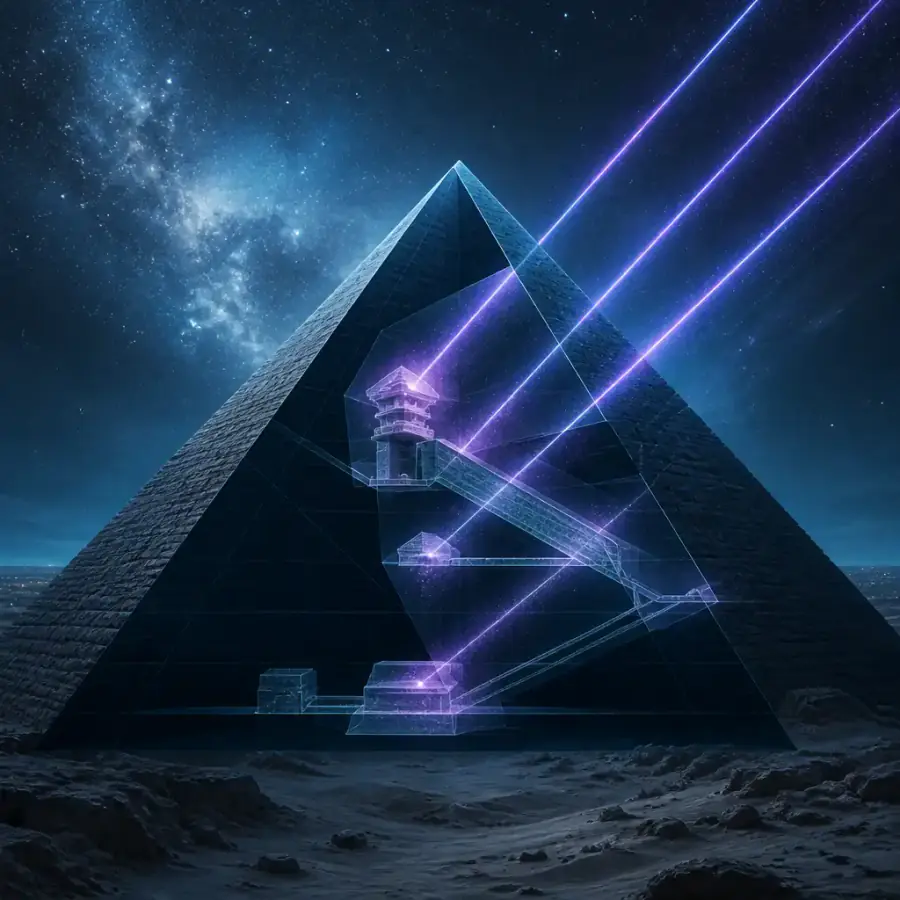
The existence of the 'Grand Void' within the pyramid, and its unknown function, adds another layer to the Great Pyramid's enduring enigma. While some hypothesize it could be one or multiple rooms, inclined or flat, or even a structural relief designed to prevent collapses, its true purpose remains a mystery, as noted by Pesquisa FAPESP. This discovery intensifies the long-standing debate about why the Great Pyramid of Khufu was found empty. Unlike other royal tombs, it contained no mummy of the pharaoh, no treasures, nor any funerary equipment when archaeologists first accessed it, as Infobae highlights. The main theory attributes this to ancient tomb raiding, but legends persist of hidden chambers or alternative burial sites. These new technological insights fuel these hypotheses, suggesting that the pyramid still guards secrets about Khufu’s final resting place or the monument’s broader symbolic role.
Giza's Unfinished Story
The discoveries near the pyramid, utilizing GPR and ERT, further underscore that the entire Giza plateau remains a treasure trove of undiscovered history. These techniques, which send radio waves or electrical currents into the earth to detect density variations, effectively create an X-ray of the desert floor. The finding of deep, geometrically precise, man-made structures beneath the Western Cemetery demonstrates that even seemingly barren land in Giza holds significant archaeological potential. It forces us to question what we truly know about this monumental site and the civilization that built it. The Giza plateau may still be guarding secrets, cloaked beneath seemingly ordinary sands, just waiting for the right blend of scientific curiosity and technological innovation to bring them to light.
Ultimately, these breakthroughs confirm that the story of ancient Egypt is far from finished. The combination of cosmic-ray physics and other advanced imaging technologies has opened an entirely new chapter in understanding these ancient wonders. It's a powerful reminder that sometimes, the most profound discoveries come not from breaking ground, but from seeing through it, allowing us to listen to the earth as it continues to tell its magnificent, millennia-old tale.
No topics yet: start the first one.
More stories
Milt Windler's Lasting Legacy: Why Human Ingenuity Still Trumps Tech
The passing of Milt Windler, a pivotal NASA flight director during the Apollo 13 crisis, reminds us that human ingenuity, calm under pressure, and collaborative leadership remain irreplaceable, even in our increasingly automated world.