Beta Pictoris b's Radio Signals: Unlocking Exoplanet Magnetic Secrets
The first definitive radio detection from an exoplanet, Beta Pictoris b, marks a monumental shift, offering an unprecedented view into distant planetary magnetic fields and their role in habitability.
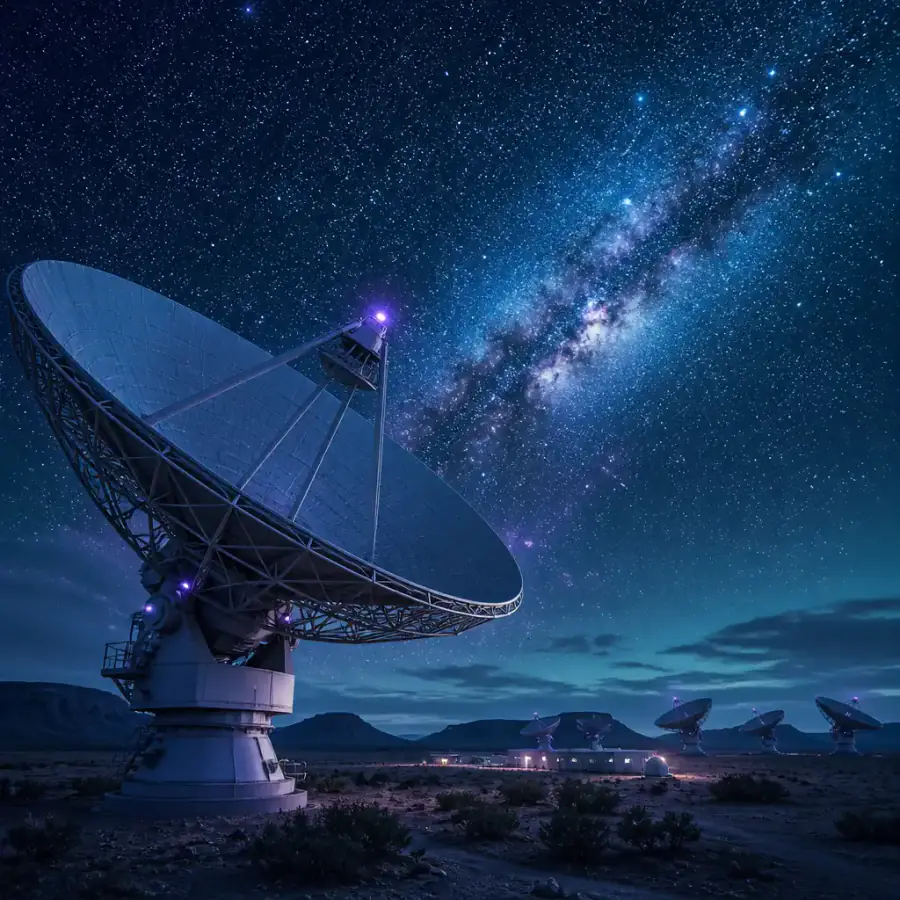
AI-generated image
When news breaks about a radio signal from an exoplanet 63 light-years away, it's easy for our minds to leap to visions of extraterrestrial intelligence. But the recent groundbreaking detection from Beta Pictoris b, a massive world orbiting a distant star, is not about finding E.T.; it's about something arguably more profound for our understanding of the universe: gaining a completely new way to 'see' and study planets beyond our solar system.
Astronomers from the Center for Astrophysics Harvard & Smithsonian and the University of Oregon have, for the first time, definitively identified radio signals originating directly from an exoplanet. Using the MeerKAT radiotelescope in South Africa, a team observed Beta Pictoris b in four sessions between 2025 and 2026, capturing brief, recurrent bursts and a more persistent emission in the 0.85 to 3.5 GHz range. Crucially, by employing super-bright galactic cores known as quasars as reference points, the researchers were able to pinpoint the signals as coming from the planet itself, not its host star, a distinction that had eluded previous efforts to identify radio emissions in exoplanetary systems.
Unlocking Magnetic Secrets from Afar
The real significance of this discovery lies in what these radio waves reveal. The signals exhibit intense circular polarization and align with a phenomenon called Electron Cyclotron Maser Instability (ECMI), the same process responsible for the auroras we see on Earth and Jupiter. This isn't just a fascinating cosmic light show; it's a direct window into the planet's magnetic field. As Edo Berger, a co-author of the study published in arXiv, highlighted, "to be able to observe radio waves that reach the frequencies we have detected, an incredibly strong magnetic field is needed."
Indeed, the data suggest Beta Pictoris b possesses an extraordinarily intense magnetic field, thousands of times superior to Earth's and approximately 2,500 times stronger than our planet's surface field. The researchers calculate a minimum field strength of 1,250 gauss in the emission zone. This constitutes the first direct measurement of an exoplanet's magnetic field strength, aligning with theoretical models for young, massive gas giants. Such a powerful field is likely fueled by Beta Pictoris b's characteristics: a mass approximately 10 to 12 times that of Jupiter and an astonishingly rapid rotation, completing a full spin in just eight or nine hours.
Why Magnetic Fields Matter for Exoplanets
Understanding the magnetic fields of exoplanets is paramount. A robust magnetic field acts as a planetary shield, protecting the atmosphere from erosion by stellar winds. This protective embrace is considered a crucial factor in a planet's potential habitability, as it helps retain water and other atmospheric components vital for life as we know it. For gas giants like Beta Pictoris b, these fields offer insight into their internal dynamos and evolutionary pathways, particularly how these colossal worlds form and retain their unique properties.
Previous attempts to detect radio signals from exoplanets, including specific observations of Beta Pictoris b, yielded no results. The breakthrough came from MeerKAT's ability to observe in a higher frequency range (0.85 to 3.5 GHz), contrasting with earlier searches focused on lower frequencies (250 to 500 MHz). This highlights the importance of technological advancements in observational astronomy and adapting methodologies based on theoretical predictions of auroral emission frequencies.
The Road Ahead: New Targets and Next-Gen Telescopes
While the current research is still a preprint awaiting peer review, its implications are far-reaching. The team has already identified seven other giant exoplanets across five nearby star systems as potential targets for this same technique. Their estimates suggest that an improvement of just five to seven times in the sensitivity of future radiotelescopes could bring these worlds within detection range. This indicates a promising new era for exoplanetary science, moving beyond mere detection to a more detailed characterization of these distant worlds.
In our view, this discovery firmly cements radio astronomy as an indispensable tool for exoplanet research. It moves us beyond solely relying on light-based observations to a new frontier, providing vital clues about planetary interiors, atmospheric retention, and ultimately, the prevalence of potentially habitable environments across the cosmos. It’s not about finding alien broadcasts, but about decoding the natural symphony of the universe itself, one powerful magnetic field at a time.
No topics yet: start the first one.
More stories
Mars' Cleaner Ice Rewrites Its Violent Climate Story
A re-evaluation by the University of Washington has drastically cut the estimated dust in Mars' northern polar ice cap to about 3%, fundamentally altering our view of the planet's past climate and water history.

Why NASA's Moon Base Science isn't Just Research, It's Survival
The latest science investigations for NASA's lunar South Pole base are more than academic pursuits; they are critical blueprints for a safe, sustained human presence and a launchpad for deep-space exploration under the Artemis program.

Beyond Webb: Why NASA's Prima telescope promises unseen cosmic revelations
NASA's new far-infrared space telescope, Prima, is a critical leap in astrophysics, set to unlock mysteries about planetary water acquisition and black hole growth beyond even the James Webb's perception.

NASA and IBM's Lunar AI: A Leap for Accessible Space Science
The open-source Lunar Foundation Model from NASA and IBM is poised to revolutionize lunar research, making decades of complex data available for unprecedented discoveries.