Beyond Footprints: Nuclear Power and Lunar Caves Pave the Way for Permanent Space Presence
NASA's dual push for advanced nuclear propulsion and the discovery of lunar lava tubes signals a profound strategic pivot towards enabling long-term, self-sustaining human outposts on the Moon and Mars.
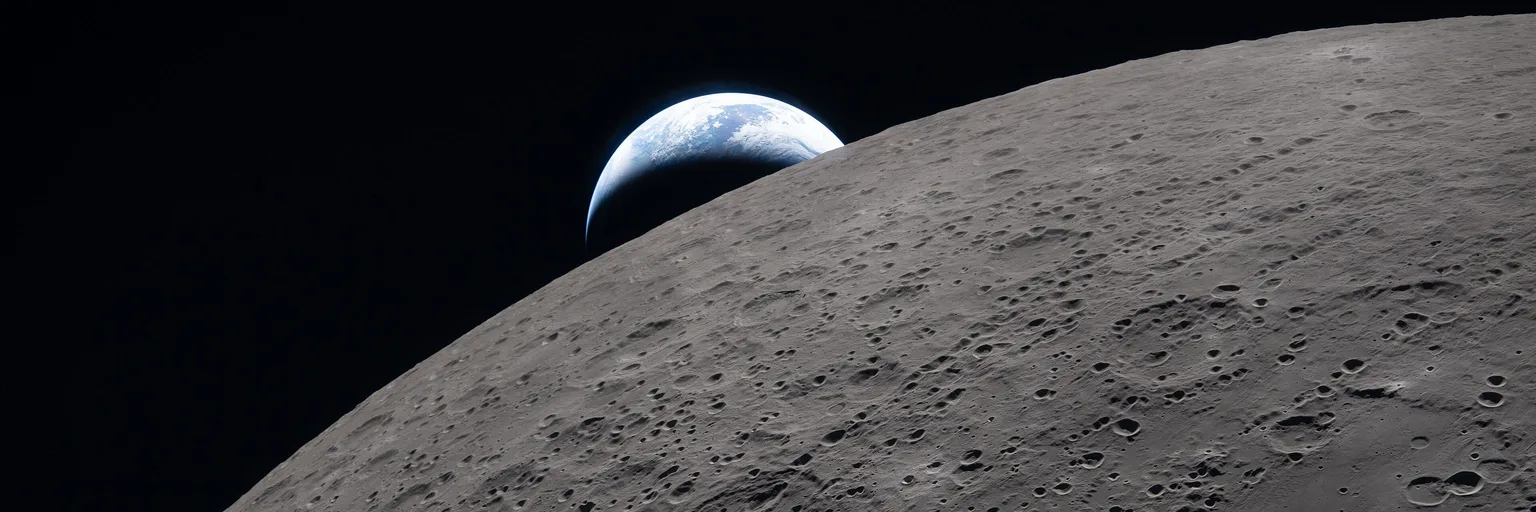
AI-generated image
Are we finally moving beyond flags and footprints in space exploration, towards a future where humanity truly lives off-world? Recent announcements from NASA suggest a resounding yes. The agency's renewed commitment to nuclear power for deep space missions, solidified by a new agreement with the Department of Energy, coupled with the GIMLI mission's quest to locate hidden lunar lava tubes, represents more than just a series of independent projects. In our view, these initiatives are foundational pillars of a cohesive, long-term strategy to establish a sustained human presence on the Moon and eventually Mars.
Just days ago, NASA and the U.S. Department of Energy (DOE) signed a Memorandum of Understanding titled “Accelerating American Leadership in Space Nuclear Power and Propulsion,” setting a framework for end-to-end collaboration [6]. This follows recent White House directives, including a December 2025 Executive Order, pushing for a launch-ready lunar surface reactor by 2030 [6]. Simultaneously, NASA has selected the GIMLI (Geophysical Instruments for Marius Lunar pit Investigation) mission, a bold endeavor to confirm the existence of vast, natural underground shelters on the Moon [1]. Together, these developments speak to an ambitious vision for permanent human settlements beyond Earth.
Nuclear Power: The Indispensable Engine for Deep Space
The most pressing challenge for any long-duration human mission beyond Earth orbit is power. Chemical rockets, while powerful for launch, are simply not efficient enough for the demands of deep-space travel or sustained habitation. This is where nuclear power becomes not just an advantage, but a necessity. The signing of the new agreement between NASA and DOE signals a significant step towards fulfilling this need, with NASA Administrator Jared Isaacman declaring that "We are entering the ‘Nuclear NASA-era'" [6].
For Mars missions, nuclear thermal propulsion (NTP) systems offer game-changing capabilities. They can reduce travel times to Mars by up to 25%, drastically limiting crew exposure to cosmic radiation during transit [7]. This is achieved by their superior efficiency, with an initial target specific impulse of 900 seconds, double that of chemical rockets [7]. The upcoming Space Reactor-1 Freedom (SR-1), set to launch in 2028, will be the first fission-powered spacecraft to travel beyond Earth's orbit, paving the way for operational deep-space applications [6, 21]. Beyond propulsion, nuclear fission surface power systems, like the planned Lunar Reactor-1, are critical for powering future Moon Bases, energizing habitats, communications, instruments, rovers, and resource utilization through the Moon's long, dark nights [6]. It's a fundamental shift from fleeting visits to continuous operation, echoing a capability first explored decades ago with the NERVA program [7], and now re-emerging with renewed strategic purpose.
Lunar Lava Tubes: Nature's Readymade Shelters
While nuclear power addresses the energy demands, the GIMLI mission tackles another existential challenge for lunar and Martian explorers: protection from the harsh environment. The lunar surface offers no cover from harmful radiation, micrometeoroids, or extreme temperature swings [1]. This is precisely why the hunt for lava tubes, long theorized but never confirmed on the Moon, is so critical. The GIMLI mission will investigate the Marius Hills Pit, a large opening in a volcanically active region, which scientists believe could be a skylight into a hidden underground tunnel [1, 4].
Lunar lava tubes, formed similarly to their terrestrial counterparts but potentially much larger—up to 1,260 feet wide compared to Earth's 100 feet due to weaker lunar gravity—could provide ideal natural shelters [1]. The GIMLI mission, led by the Planetary Science Institute, plans to use an array of instruments, including ground-penetrating radar, seismic sensors, a gravimeter, and cameras, to map and characterize the subsurface around the Marius Hills Pit [1, 4]. This ground-breaking, direct investigation, a return to active-source seismic methods not seen since the Apollo era, will either confirm the existence of these subterranean havens or provide invaluable geological insights into the Moon's volcanic history [3, 4]. The implications for astronaut safety and the preservation of scientific equipment are immense; these natural caverns could be humanity's first true homes beyond Earth.
A Unified Strategy for Enduring Presence
It is tempting to view these developments in isolation, but their true significance emerges when seen as synergistic components of a grander strategy. Nuclear power provides the energy to get there and stay there, while lunar lava tubes offer the ready-made infrastructure for protection and habitation. NASA Administrator Isaacman's recent update that the first elements of the Moon Base will launch in December, ahead of the original 2030 goal, further underscores the agency's accelerated timeline and commitment to establishing a lasting foothold [8].
The integration of advanced nuclear technologies with the search for natural shelters represents a strategic pivot from episodic exploration to establishing a self-sustaining, long-term human presence in space. This isn't merely about returning to the Moon; it's about building permanent outposts, creating an "ultimate interplanetary survival guide" for future astronaut crews [1]. These efforts are about equipping humanity with the fundamental capabilities to not just visit, but to live and thrive on other celestial bodies, pushing the boundaries of what is possible in deep-space exploration and securing a future beyond Earth's confines.
Ultimately, the path to Mars and a sustained lunar presence is being forged by addressing these core challenges of power and shelter. With nuclear power promising to shorten journeys and sustain operations, and lunar caves offering the promise of natural protection, the "Nuclear NASA-era" and the GIMLI mission are not just advancing science; they are building the infrastructure for humanity's enduring future in space.
No topics yet: start the first one.
More stories
Mars' Moons Hold Solar System's Secrets: MMX Mission Ready to Deliver
The upcoming MMX mission, a collaboration between Japan, France, and other nations, is poised to solve the enduring mystery of Mars' moons and offer unprecedented insights into our solar system's tumultuous early days.
The Universe’s Oldest Fast Radio Burst Challenges Its Origins
The discovery of the most distant Fast Radio Burst, detected by MeerKAT and pinpointed by the James Webb Space Telescope, provides unprecedented insights, forcing us to rethink how these enigmatic signals originate in the early universe.

Cosmic Alchemy's Crucible: X-rays Reinforce Gold's Violent Birth
A distant flash of X-rays from colliding neutron stars offers compelling new evidence, deepening our understanding of how precious metals like gold are forged in cataclysmic cosmic events.

Human Eyes Still See What Machines Miss: Artemis II Proves It
NASA's Artemis II mission delivered a treasure trove of data, but it's the astronauts' unique observations of lunar impacts and strange colors that underscore humanity's indispensable role in space science.